
If you’re a UK tradesperson, the choice is simple at the start: use cash basis if you want your books to follow money in and money out, and use accrual if you need your accounts to track invoices, bills, stock and work in progress. Since 2024/25, cash basis is the default for many sole traders and partnerships.
Here’s the short version:
- Cash basis records income when you get paid and costs when you pay them.
- Accrual records income when you invoice and costs when the bill lands.
- Cash basis often suits short jobs, fast payments and simpler admin.
- Accrual often suits staged invoices, supplier credit, unpaid bills and longer projects.
- Under both methods, petty cash still needs receipts, dates, amounts and job references.
- Small missing spends, often under £50, can build up and skew job profit and tax records.
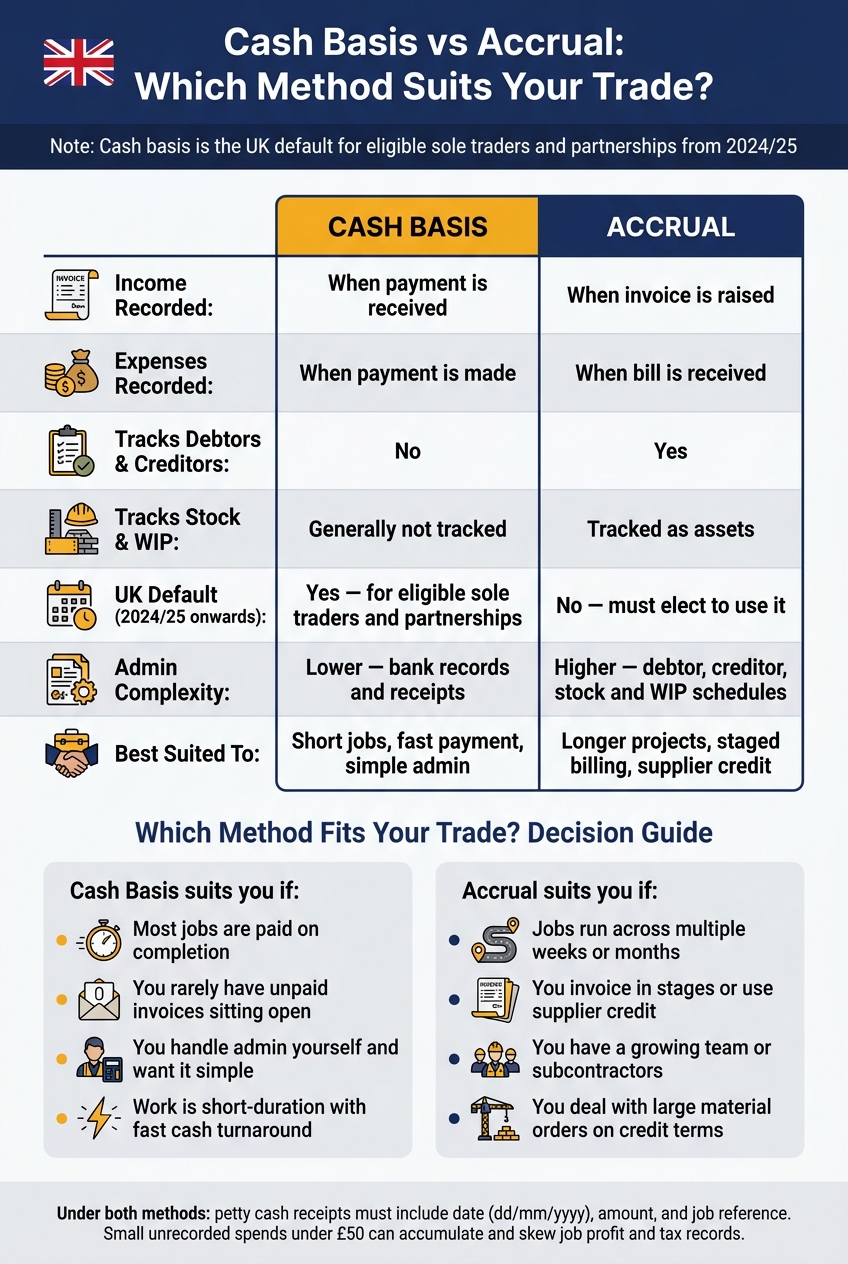
Cash Basis vs Accrual Accounting: UK Tradespeople Quick Guide
Switching Cash Basis to Accruals: Sole Trader Guide for 2026
sbb-itb-12417dd
Quick comparison
| Point | Cash basis | Accrual |
|---|---|---|
| Income recorded | When money is received | When invoice is sent |
| Costs recorded | When money is paid | When cost is due |
| Unpaid customer invoices | Not counted yet | Counted |
| Unpaid supplier bills | Not counted yet | Counted |
| Stock and WIP | Usually not tracked in the same way | Tracked |
| Best fit | Small trade jobs, fast payment | Longer jobs, staged billing, credit terms |
| UK position from 2024/25 | Default for many eligible sole traders and partnerships | You choose it if you want to use it |
I’d sum it up like this: pick the method that matches how your jobs are priced, billed and paid. If cash moves fast, cash basis may be enough. If work, invoices and costs land at different times, accrual usually gives a more accurate view of each job.
Cash basis and accrual: what each method means for UK tradesmen
From the 2024/25 tax year, cash basis became the default accounting method for eligible sole traders and partnerships in the UK. If you're a self-employed tradesperson, that matters because it changes how you record income and costs in day-to-day work.
Cash basis: recording money as it comes in and goes out
With cash basis, you record income only when the money lands in your account. You record an expense only when you’ve paid it. Simple.
That’s why this method often works well for tradesmen doing shorter jobs and getting paid soon after the work is done. Your accounts tend to match your cash flow more closely, which can make Self Assessment a bit easier to deal with.
Accrual: recording income and costs when they are earned or incurred
Accrual works in a different way. You record income when it is earned - usually when you send the invoice - even if the customer pays later. You record costs when they are incurred, such as when a supplier sends the bill, not when you actually pay it.
This method also tracks things cash basis does not, like debtors, creditors, stock and work in progress (WIP). So if you want a clearer view of how the business is doing, accrual gives you that. It is mandatory for limited companies and often makes more sense for longer projects or jobs with more involved credit terms.
| Cash Basis | Accrual | |
|---|---|---|
| Income recorded | When payment is received | When invoice is raised |
| Expenses recorded | When payment is made | When bill is received |
| Tracks debtors/creditors | No | Yes |
| Best suited to | Sole traders, short jobs | Limited companies, long projects |
| UK default (2024/25 onwards) | Yes, for eligible sole traders and partnerships | No |
Cash basis vs accrual: key differences for tradesmen
The main difference is timing. And that timing affects your taxable profit.
If you finish a job, send the invoice, and get paid later, accrual records the income when the invoice is raised. Cash basis records it when the money lands in your account.
That can make accrual show a higher profit on paper, even when the cash still hasn’t hit your bank. For tradesmen juggling wages, supplier bills and material costs on live jobs, that gap matters.
Tax and compliance
For eligible sole traders and partnerships, cash basis is the default. If you want to use accrual, you need to elect for it.
| Tax point | Cash basis | Accrual |
|---|---|---|
| HMRC status (2024/25 onwards) | Default for eligible sole traders and partnerships | Optional; you elect to use it |
| Taxable profit based on | Cash received minus cash paid in the tax year | Income earned minus costs incurred, regardless of payment |
| Year-end debtors | Not included in taxable income | Included - unpaid invoices count as income |
| Year-end creditors | Not deducted | Deducted as costs already incurred |
| Stock and WIP at year-end | Generally expensed when purchased | Valued as an asset; matched against related revenue |
| Switching method | Transition adjustments needed to avoid double-counting | Opening figures must reflect closing accrual balances |
This gap shows up most clearly on active jobs, where customer payments, supplier invoices and stage payments rarely line up neatly.
Switching between methods also needs care. You need to adjust opening figures so income and costs aren’t counted twice, or missed altogether. In plain English: if the opening and closing figures are wrong, the tax result will be wrong too.
Record-keeping and reporting differences on trade jobs
The tax timing also changes the amount of admin involved.
Cash basis is simpler. You’re mainly working from bank records and receipts, without debtor, creditor or WIP schedules.
Accrual needs more tracking. You’ll need records for:
- debtors
- creditors
- stock
- WIP
That extra work can pay off on multi-stage jobs because it gives you a clearer view of what each job is making.
On site, that leads to the next practical issue: how do you record small cash spends without losing control at job level? These timing rules also shape how you deal with petty cash, receipts and job-by-job cost tracking on site.
Job-based cash tracking and petty cash under both methods
Petty cash is often the first place job costs slip through the cracks. A few small spends with no record can throw off both job margins and tax figures. That hits hardest on site, where quick purchases are easy to miss.
Petty cash records: receipts, float checks and weekly check
A fixed petty cash float keeps site spending under control. When someone takes money from the float, they should leave a receipt or a signed voucher in its place. At the end of each week, the cash left in the tin plus the total on those receipts should match the original float. If it doesn’t, money or paperwork is missing.
Each receipt needs three details:
- the date in dd/mm/yyyy format
- the amount
- the job reference
That job reference does a lot of heavy lifting. Without it, a materials receipt is just another cost. Add the reference, and it becomes part of the margin for a specific project, so you can place it in the right records.
Missing receipts make job costs look lower than they are and profit look higher than it is. In manual systems, most expense issues sit below £50 - small enough to dodge a quick review, but common enough to pile up fast.
Using Site Wallet for receipt capture and job tagging
Digital capture cuts out the lag between spending cash and logging it. Site Wallet scans receipts, pulls in the vendor, total, date and category, and tags each spend to a job. You can then export the record as CSV, PDF or ZIP for your accountant.
How petty cash treatment differs between cash basis and accrual
The receipt trail stays the same under both methods. What changes is the accounting entry.
| Cash basis | Accrual | |
|---|---|---|
| Recording method | When cash leaves the float | When the cost is incurred |
| Reconciliation focus | Remaining cash plus receipts should equal the original float | Petty cash ledger versus the general ledger |
| Job tagging impact | Affects the immediate cash flow report for that job | Feeds WIP and long-term project margin analysis |
| Tax records | Deducted in the period when paid | Deducted in the period when incurred |
Day to day, the routine is much the same: keep the receipts, add the job references, and check the float on a regular basis. Under cash basis, that information goes straight into your cash records. Under accrual, it runs through a petty cash ledger account instead.
When to switch accounting methods as the business grows
Signs cash basis still fits a small trade operation
As jobs get bigger, the main issue often shifts. It’s no longer just about day-to-day cash flow. It becomes about unpaid invoices, staged billing, and supplier credit.
Cash basis still works well when the work is simple and customers pay fast. If most jobs are settled on completion and you rarely have invoices sitting unpaid, cash basis gives you a plain view of what’s actually in the bank. For many small trade firms, that matters more than anything else.
It’s also the simpler route if you handle the admin yourself and want to keep paperwork under control.
Signs accrual is likely better for larger or more complex work
Accrual tends to make more sense when jobs are larger, payment terms stretch out, invoices are raised in stages, or supplier and subcontractor costs run across more than one period. The same applies when you’re placing large material orders on credit or dealing with subcontractor costs that don’t fall neatly into a single month.
One practical red flag is when your month-end close keeps sliding by two or three weeks because receipts and vouchers are still being chased. That usually means the current setup is under pressure. At that stage, accrual is often the better fit.
Before making the change, review any income and costs already recorded under cash basis so nothing gets counted twice or left out. An accountant who knows UK trade businesses can help you move across cleanly.
Conclusion: pick the method that matches how the business earns and spends
Use the table below to match the method to the way your jobs are billed and paid.
| Trade scenario | Better fit | Why |
|---|---|---|
| Urgent repairs, paid same day | Cash basis | Simple cash-in/cash-out and low admin overhead |
| Repeat low-ticket work | Cash basis | Straightforward recurring collection |
| Scheduled remodel with staged payments | Accrual | Tracks earned income before cash is collected |
| Large material orders on supplier credit | Accrual | Matches liabilities to the period work is done |
| Growing team or subcontractors | Accrual | Better for payroll liabilities and statutory compliance |
| High volume of partial invoices | Accrual | Helps prevent reconciliation from becoming unmanageable |
The best method is the one that matches how money moves through the business. Cash basis suits simple work that gets paid fast. Accrual suits longer jobs built around credit, staged invoices, and costs that land at different times.
FAQs
Can I change from cash basis to accrual later?
Yes, you can move from cash basis to accrual basis later as your business grows.
Cash basis is often simpler for smaller tradesmen. But as the business gets busier, accrual accounting can make more sense. It gives you a clearer view of money coming in, money going out, and what the business actually owes or is owed.
This switch may also become necessary if your business gets more complex, needs tighter reporting, or goes beyond certain turnover limits.
You’ll also need to adjust your records for tax purposes, so it’s a good idea to speak to a qualified accountant.
Which method gives a clearer view of job profit?
Accrual accounting usually gives a clearer picture of job profit. It matches income and costs to the point when they’re earned or incurred, so you can see how a job is actually performing.
The cash basis is simpler, but it only shows money coming in and going out. That can muddy the picture of profit if, say, materials are bought in one month and the work is invoiced in another. Site Wallet can help by tagging expenses to specific jobs.
What records do I need to keep for petty cash?
Keep proof for every petty cash transaction when you spend it. That means:
- a receipt copy or photo
- the transaction date
- the amount paid
- the vendor name
- the job or cost head
Site Wallet can scan receipts, pull out the key details, and sort each expense by job. That gives you a clear digital audit trail for tax prep and expense reporting.