
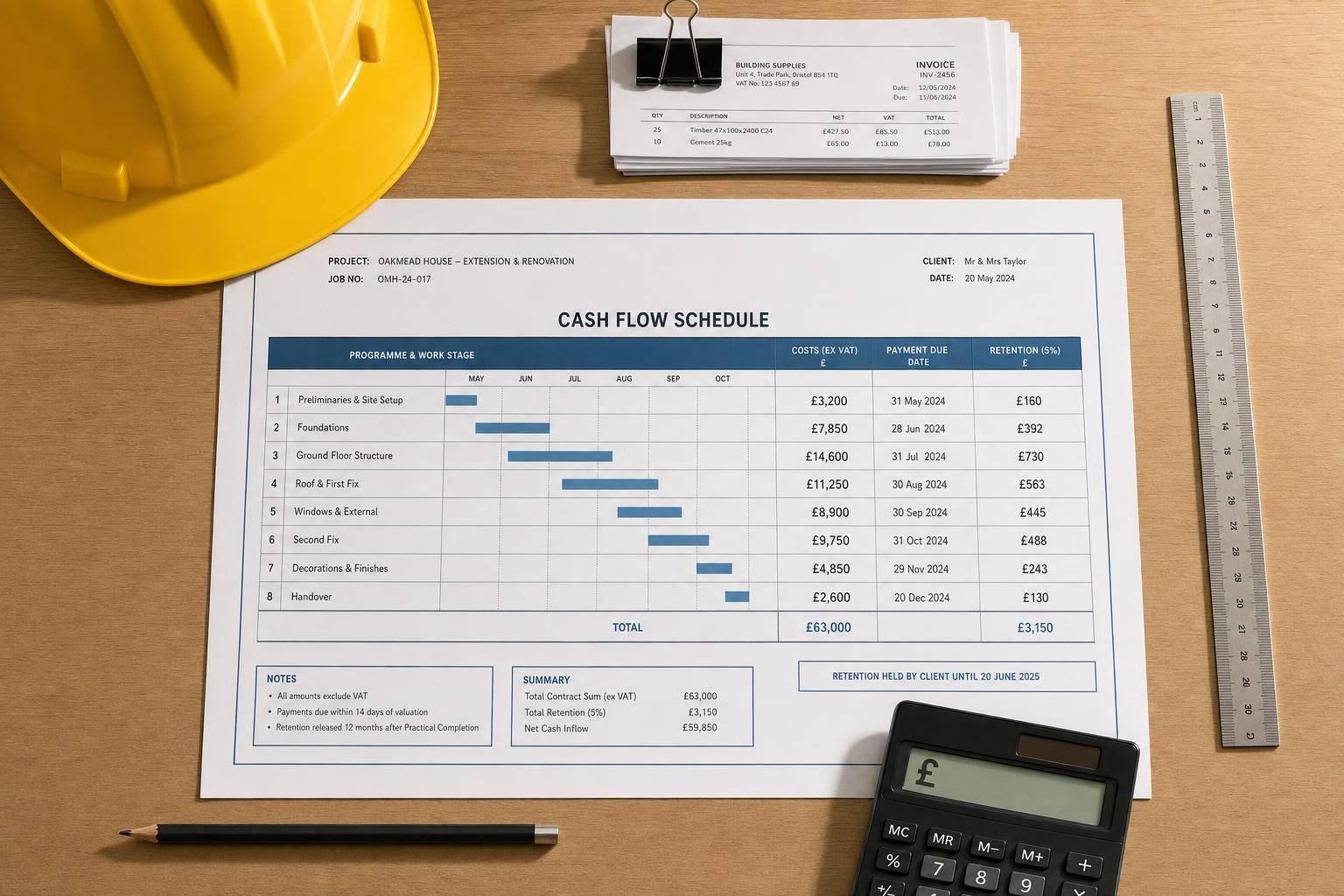
Why Cash Flow Tracking Matters on Every Job
A job can show profit and still leave me short of cash. That happens when I pay for labour, materials, fuel, plant hire, and subcontractors before the client pays me. In UK construction, payment can take around 45 days, and 5%–10% retention may be held even longer.
If I want to know what a job is actually doing for my business, I need to track more than the final invoice. I need to log:
- every cost
- the date each payment goes out
- the date each customer payment clears
- any retention still being held
- estimated spend vs actual spend
That is the short version: job-level cash tracking shows where the money goes, where it gets stuck, and which jobs put pressure on cash. It also helps me fix underpricing before it keeps happening.
A few numbers make the point clear:
- Around 80% of UK construction projects go over budget
- Average payment time is about 45 days
- Retention is often 5%–10%
- One contractor improved average margin by more than 3% after tracking actual material costs and fixing under-quoted items
So when I track each job properly, I can:
- spot small costs that chip away at margin
- see which clients pay late
- check whether spend is running ahead of the job
- price the next job with better figures
- keep cash steadier week to week
In simple terms, this is not just about profit on paper. It is about whether a job leaves me with money in the bank when bills are due.
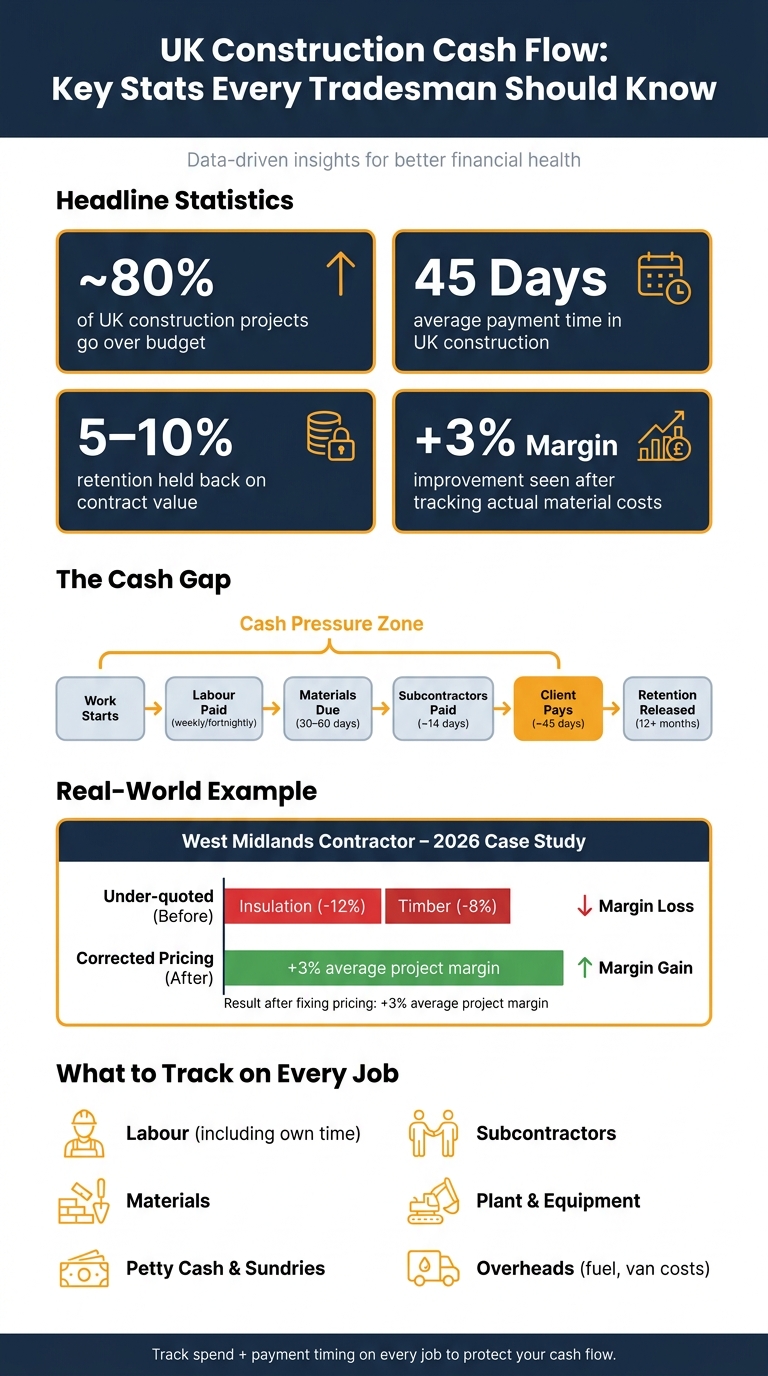
UK Construction Cash Flow: Key Stats Every Tradesman Should Know
Cash flow template by job for construction contractors
sbb-itb-12417dd
The cash flow problems that catch tradesmen out
The real issue sits in the gap between the quote and the payment. That’s where margin starts to slip. Small costs pile up, and cash goes out before any money comes back in.
Small site costs quietly eat into margin
A job can look decent on paper, then start to shrink once the extras creep in. A bag of fixings from Screwfix. A tube of sealant you didn’t include in the quote. Parking for a town-centre job. Diesel for another run to the merchant. A replacement drill bit after the old one gives up.
None of those costs looks like a big deal on its own. Put them together across a project, though, and they can add up fast.
Consumables are a common problem. Saw blades, screws, dust sheets and sealant are easy to miss when pricing a job. But they still hit your bottom line. If you don’t track them properly, they disappear into overheads, and the job can seem more profitable than it was.
You pay first and get paid later
This is where a lot of tradesmen get squeezed: timing.
Labour often goes out weekly or fortnightly. Materials may be due in 30 to 60 days. Subcontractors usually want paying within a fortnight. Meanwhile, customers in UK construction can still take around 45 days to pay, which leaves the business covering the gap.
And that’s the sting. A job can still make money overall and yet put pressure on cash day to day. You only see that clearly when each outgoing and incoming payment is linked to the job and the date it clears.
No job-level tracking means pricing mistakes keep happening
If you don’t track costs at job level, it’s hard to see what’s causing the shortfall. So the same pricing errors show up again on the next job, and the one after that.
You won’t spot which jobs keep running over on materials. You won’t see where petty cash, fuel or subcontractor payments are eating away at the margin. And you won’t have a clear view of which clients always seem to pay late.
"Without a job-by-job breakdown, you are effectively flying blind. You're making critical business decisions... based on a vague, historical average." - James Lennon, WorkBookPro
One West Midlands contractor saw this first-hand. In early 2026, they tracked every material purchase against their original estimates. After three months, the numbers showed a clear pattern: they were under-quoting insulation by 12% and timber by 8%. Once they adjusted their pricing to match what they were actually spending, their average project margin went up by over 3%.
That kind of detail only shows up with job-level tracking. It shows you which costs keep pushing cash out, and which clients make the pressure worse.
That is why the next step is comparing what you expected to spend with what the job actually cost.
What to track on every job to see the real cash position
To see what cash a job is actually producing, you need the same core data on every project, every time.
For most jobs, that means tracking five main cost areas: labour (including your own time), materials, petty cash and sundries, subcontractors, plant and equipment, and overheads such as fuel and van running costs. Leave one out and the picture is off. The goal is simple: track both spend and payment timing for each job, not just the final invoice value.
Track estimated versus actual spend
Before work starts, take your original quote and set a budget limit for each cost category. Then, as the job moves along, log what you spend against that limit.
This is where problems show up early. If a job is only 20% done but 40% of the materials budget has already gone, you still have time to act. If you spot it late, the margin may already be gone.
"If you are 20% through the project and 40% through your materials budget, you have a problem that needs addressing now." - FORGE Command
A simple habit helps here: spend 30 minutes every Friday reviewing open jobs and comparing actual spend with each budget line. That only works if costs are entered as they happen, not days later when details start to blur.
Log every outgoing and incoming cash movement
For every transaction, record four things:
- the date
- the exact amount
- the supplier or customer
- the job reference
Do this for everything, including small purchases like sealants, screws, and fuel. Those little spends add up fast, and they are often the first ones people miss.
A practical trick: photograph receipts on your phone as soon as you buy. If one supplier trip covers materials for two jobs, split the cost between those jobs there and then. Waiting until later usually turns into guesswork.
Monitor payment timing, not just invoice totals
The invoice total tells you what you should get paid. It does not tell you when that money will hit your bank account. And when wages are due on Friday, that gap matters.
Track:
- the invoice date
- the agreed payment terms
- any deposit or stage payments
- retentions
- the date the money actually clears
In UK construction, average payment times sit at around 45 days. So the gap between issuing an invoice and getting paid can easily stretch to six weeks. Then there is retention, which is often 5–10% of the contract value held back for 12 months or more.
That is why it helps to keep a simple retention register with the amount held, the job reference, and the expected release date. When that date comes round, you can chase it straight away instead of leaving money sitting on the table.
Once all of that sits in one place, reviewing open jobs gets much easier.
A simple job-based tracking method that works on site
The easiest way to stay on top of job costs is simple: log each cost when it happens, tag it to the right job, and check open jobs once a week.
Capture receipts and purchases as they happen
One habit makes a big difference: take a photo of each receipt as soon as you pay. Site Wallet’s mobile receipt scanning lets you do that on your phone and tag the receipt to the right job there and then. If one purchase covers materials for two jobs, split the cost when you log it instead of trying to piece it together later from memory.
"Record costs on the day they happen. Do not wait until the end of the week." - FORGE Command
See all job spend in one place
When receipts are tagged, you get a live total for each job. As soon as a receipt is logged, the total updates automatically. That means you can see petty cash, fuel, merchant purchases, and subcontractor costs together in one view. If spend is going up faster than the job is moving, you can catch it early enough to do something about it.
Review open jobs weekly and export records when needed
A short Friday review is often enough to check spend against budget, flag overdue invoices, and spot payment gaps that are starting to grow. Site Wallet tracks cash flow job by job, so the numbers are already waiting for you when it’s time to review. When a job is finished, you can export the full record as a PDF or CSV for CIS and VAT records. That keeps everything ready when you need it.
Conclusion: better tracking leads to better pricing and steadier cash
Cash flow problems usually start with a simple issue: you can't clearly see costs, receipts, and payment dates at the job level. Track those details job by job, and things look very different. You can spot which jobs made money, which ones quietly drained it, and what caused the gap.
That is why the numbers matter. Around 80% of UK construction projects run over budget. That is not just bad luck. In many cases, it comes back to weak tracking. When you compare actual spend with the original estimate on every job, the same pricing errors are much harder to miss.
Payment timing matters just as much. The average payment time in UK construction is 45 days. That delay is where cash pressure starts to build. If you track it on each job, you can see trouble ahead and step in before it turns into a bigger issue.
Once you track both spend and payment timing, the next step is pretty simple:
- log costs as they happen
- tag each cost to the right job
- review open jobs every week
Do that consistently, and you get better pricing, earlier warning signs, and steadier cash flow.
FAQs
How often should I review cash flow on each job?
Review cash flow for each job every week, usually on Friday. That gives you a clear view of actual spend against the budget, so you can spot problems early and deal with them before they grow.
Which job costs are easiest to miss?
The job costs that slip through the cracks most often are the small ones. They don’t look like much on their own, but they add up fast.
That usually includes:
- consumables
- tool and equipment depreciation
- van running costs
- warranty call-backs
It’s easy to brush these off as part of day-to-day work. But if you don’t price them in, they chip away at your profit without much warning.
How can I track retention properly?
Keep a retention register that tracks every sum held back, what’s due, and the date each amount should be released. Then act on it. Send retention release requests as soon as you’re entitled to payment instead of letting them sit.
You can also use retention bonds in place of cash retention to help cash flow. If you work with the same clients again and again, try negotiating a lower retention percentage. And where you can, ask for retention money to be kept in protected bank accounts.