

Cash vs Card for Small Crews: What Works Best
Managing expenses for small tradesman crews in the UK boils down to cash versus card. Which works better? Here's the answer: a mix of both. Cash is handy for quick, small purchases like materials, especially in areas with poor mobile coverage. However, cards shine for larger payments, staged transactions, and keeping accurate records.
- Cash Pros: Immediate settlement, no processing fees, and useful for offline transactions.
- Cash Cons: High risk of theft, manual record-keeping, and time-consuming reconciliation.
- Card Pros: Secure, automatic record-keeping, and integrates with accounting tools.
- Card Cons: Processing fees (1.5%–2.9%) and slightly slower settlement times.
Key takeaway: Use cash for small, immediate needs and cards for everything else. The real challenge isn’t the method - it’s ensuring every expense is logged promptly to avoid errors and compliance risks.
1. Cash
For small tradesman crews handling on-site expenses, cash remains a widely used option, though it comes with notable challenges.
Security
Cash poses greater risks compared to digital payments. It's physical, easy to carry, and impossible to recover if lost or stolen. As Stripe points out:
"Cash introduces risks that don't exist with electronic payments, largely because it's physical, portable, and final." – Stripe
To reduce these risks, limit the amount of cash kept on-site, store it securely in a lockbox, and make regular bank deposits to move funds into a traceable system. Additionally, separating cash handling from record-keeping duties can help prevent internal fraud.
Record-Keeping
Managing records with cash can be tricky. Since it lacks an automatic audit trail, expenses might go unrecorded, and receipts can be easily misplaced. Vergo highlights this issue:
"Petty cash tracking failures frequently occur in construction audits. Physical cash has no inherent audit trail." – Vergo
HMRC now cross-references declared income with bank deposits, debunking the idea of "invisible cash". If undeclared cash income is discovered, penalties can range from 30% to 70% of the tax owed. Using digital tools to scan and store receipts offers a simple way to create a reliable record, reducing the chances of errors or losses.
Convenience
Cash is practical for offline transactions and provides instant settlement. For example, during a quick materials run in a rural area with poor mobile coverage, cash may be the easiest option. Plus, 87% of tradespeople report that customers often request cash discounts. However, cash falls short for transactions involving deposits, staged payments, or remote billing.
Cost
While cash avoids processing fees, the time spent counting, reconciling, and depositing it can cancel out those savings. Contractors typically spend two to five hours per week managing cash. Many construction controllers now suggest switching to digital reimbursement systems, as the administrative time often outweighs any savings on transaction fees.
Next, we’ll explore how card payments can streamline expense management for small crews.
2. Card
Card payments have become a practical solution for small tradesman crews, offering benefits in security, record-keeping, and overall convenience.
Security
Card transactions automatically log details like the amount, timestamp, and often GPS data, making it easier to verify purchases. The use of chip (EMV) readers also plays a significant role in reducing fraud:
"Using chip readers also reduces card-present fraud by up to 87% and shifts fraud liability from merchants to card issuers." – David White, Senior Content Marketing Manager, Relay
In addition to fraud prevention, card systems comply with PCI DSS standards. From May 2026, the Financial Conduct Authority (FCA) will introduce stricter rules to better protect customer funds. Companies transitioning from cash advances to digital wallets have reported a 30% drop in unexplained expenses and financial leakage.
Record-Keeping
When it comes to keeping records, cards stand out. Every transaction is automatically synced with accounting tools like Xero or QuickBooks, eliminating the need for manual data entry. Many platforms even allow crew members to assign transactions to specific job numbers, ensuring accurate cost tracking for projects.
Card systems also help minimise VAT leakage - unclaimed VAT due to missing receipts - by prompting users to upload documentation immediately after purchases. For crews working under Making Tax Digital (MTD) requirements, this automated process is invaluable. Construction-specific card platforms can even cut month-end close times by three to five days.
"Construction-specific spend management cards enforce job-level budgets, require cost code attribution at the point of purchase, and integrate with construction ERPs." – Vergo
Convenience
For multi-member crews, SMS payment links are replacing traditional card readers, cutting out hardware costs and avoiding connectivity issues.
"If you have a team, payment links are almost always the cheaper, faster, and more scalable choice." – Shuttle
However, card payments do take slightly longer to settle than cash - usually one to three business days. That said, next-day settlement options are now widely available.
Cost
Card processing fees, typically ranging from 1.5%–2%, are straightforward compared to the hidden costs of cash, such as bank deposit fees, service charges, and the time spent on reconciliation. In fact, cash handling can cost field service businesses 5%–8% of their revenue, whereas card processing costs are closer to 2.6%–3%. Ultimately, the visible fees associated with card payments are often the more affordable option.
Additionally, offering card payment options can help crews secure more work. Contractors who accept multiple payment methods close 25%–35% more jobs compared to those who only take cash. This is partly because customers are not limited by the cash they have on hand. These efficiencies make card payments an attractive choice for modern tradesman crews, setting the stage for a closer look at the pros and cons.
sbb-itb-12417dd
Pros and Cons
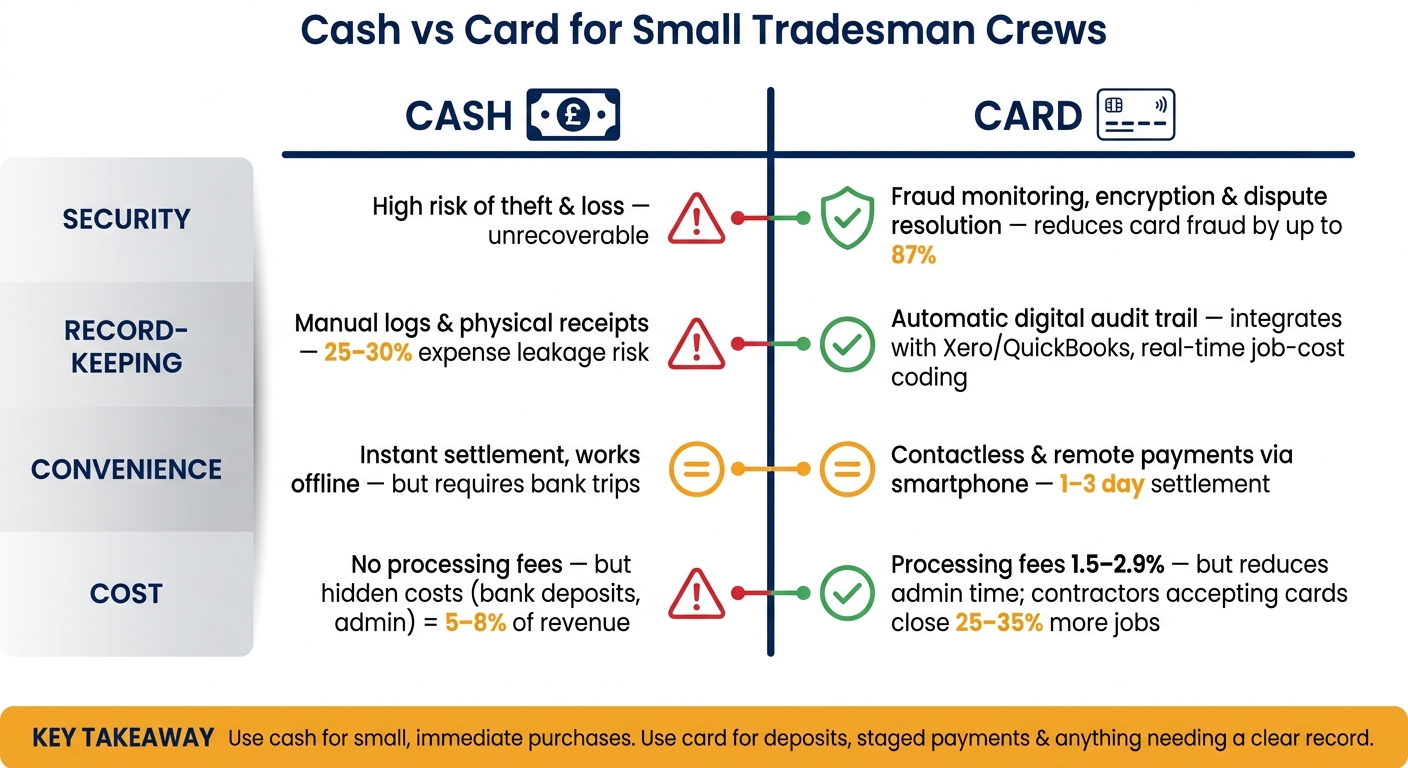
Cash vs Card for Small Tradesman Crews: Full Comparison
Here's a quick comparison of the advantages and disadvantages of using cash versus card payments:
| Cash | Card | |
|---|---|---|
| Security | High risk of theft, loss, and counterfeit bills - losses cannot be recovered | Includes fraud monitoring, encryption, and dispute resolution measures |
| Record-keeping | Requires manual logs and physical receipts, which can result in 25–30% expense leakage | Automatically creates a digital audit trail, integrates with accounting systems, and enables real-time job-cost coding |
| Convenience | Allows immediate settlement without internet but involves trips to the bank | Enables fast, contactless payments and remote transactions via smartphones, though it depends on network access |
| Cost | No processing fees, but hidden costs like bank deposit charges and administrative work can account for 5–8% of cash revenue | Processing fees of 1.5–2.9%, often balanced by reduced admin time and better job conversion rates |
This breakdown explains why many small teams are moving towards digital payment options for better expense management.
Conclusion
Managing expenses effectively is essential for keeping job costs in check. Both cash and card payment methods come with their own set of pros and cons - ranging from security to record-keeping. There’s no one-size-fits-all answer here. For most small crews, a combination of both works best: use cash for quick, small purchases like a bag of materials or a tip, and rely on cards or digital payments for deposits, staged payments, and transactions that require a clear record.
Research shows that offering multiple payment options can result in more closed jobs, with 44.1% of customers favouring card payments. Regardless of the method, the key to financial control is recording every transaction immediately. Delays in logging expenses can lead to costly errors and even compliance risks with HMRC, as previously discussed.
The bigger issue isn’t about choosing between cash or card; it’s about ensuring you have full visibility of your spending. Whether it’s a cash payment for materials or a card transaction at a supplier, every expense must be tied to the correct job right away. Postponing entries can create gaps in your records, which could lead to financial mismanagement and compliance headaches.
Consistency is the answer to avoiding these pitfalls. This is where tools like Site Wallet prove invaluable. Designed for tradesmen and small crews, Site Wallet allows you to scan receipts, tag expenses to specific jobs, and monitor your cash flow - all directly from your phone. It strikes a balance, offering the ease of cash payments alongside the accountability of digital methods, so you don’t have to compromise.
The aim isn’t to create a flawless system but to stick to a reliable one. Set clear rules: use digital payments for larger transactions or deposits, reserve cash for smaller, immediate needs, and make sure every expense is logged on the spot. This consistency keeps your records accurate, ensures compliance with HMRC, and helps protect your bottom line.
FAQs
How much cash should a small crew carry on site?
Carrying a small amount of petty cash can be a lifesaver for handling those unexpected, on-site purchases. Keep a fixed float and make sure to top it up whenever it dips below a predetermined limit. For most teams, this means sticking to a modest amount that's appropriate for occasional, low-value transactions.
To keep things organised, reconcile the cash at the end of each day, store it securely in a locked box, and assign a single person as the custodian. This way, you can ensure the cash is properly managed and accounted for.
What’s the simplest way to log cash spends without losing receipts?
The simplest way to keep track of cash expenses and avoid misplacing receipts is by using a mobile receipt capture app. These apps allow you to snap a photo of your receipts on the spot, using optical character recognition (OCR) to pull out the key details. Since HMRC accepts digital copies, you can safely dispose of the paper versions. To improve your tracking further, consider combining this with a petty cash voucher system. Record the transaction details, attach the digital receipt, and make sure to log everything in your accounting records without delay.
How do card payments affect VAT and HMRC compliance?
Card payments need valid VAT invoices for reclaiming input tax. This is because card statements or machine receipts typically miss crucial details, such as the supplier's VAT number, a description of the goods, and the applicable VAT rate. For businesses using the VAT Cash Accounting Scheme, the tax point is generally the date when the sales voucher is issued. In some cases, corporate purchasing cards can simplify this process by offering compliant invoice reports, which the bank issues on behalf of the supplier.