
If I use my own vehicle for work, I can usually claim HMRC mileage at 55p per mile for the first 10,000 business miles in a car or van from 6 April 2026. After that, the rate drops to 25p. Motorcycles stay at 24p, and bicycles stay at 20p.
Here’s the short version:
- Cars and vans: 55p per mile for the first 10,000 business miles
- Cars and vans over 10,000 miles: 25p per mile
- Motorcycles: 24p per mile
- Bicycles: 20p per mile
- Passenger payment: 5p per passenger per business mile in a car or van
- Tax year covered: 6 April 2026 to 5 April 2027
Just as important, I can claim only business journeys. That means trips to clients, suppliers, and between sites may count, but home-to-work travel to a permanent base does not. And I must use one method per vehicle: mileage rate or actual costs, not both.
A few points matter most:
- The 10,000-mile limit resets each tax year
- I cannot use mileage rates for a vehicle if I claim capital allowances on it
- Mixed trips must be split, so personal detours are left out
- My mileage log is the proof for Self Assessment
In short: this is a flat-rate way to claim vehicle costs, with less paperwork than adding up fuel, insurance, and repairs one by one.
| Vehicle | Rate | Mileage rule |
|---|---|---|
| Car or van | 55p | First 10,000 business miles |
| Car or van | 25p | Over 10,000 business miles |
| Motorcycle | 24p | All business miles |
| Bicycle | 20p | All business miles |
If I want to claim the right amount, I need to track the date, start and end points, business reason, and miles travelled for each trip.
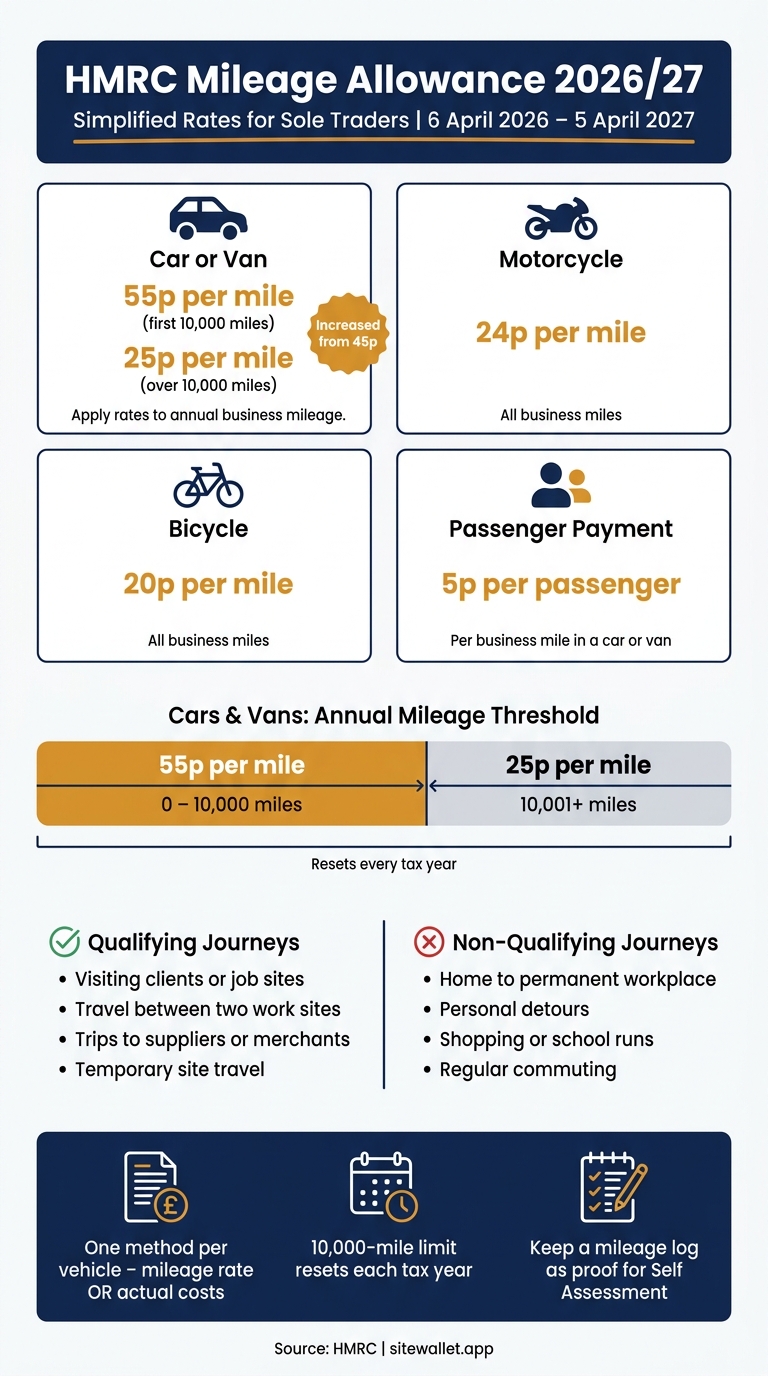
HMRC Mileage Rates 2026/27 for Sole Traders
How to Claim Mileage Back from HMRC in the UK (2025-26) | Step-by-Step Guide by Pro Tax Accountant
sbb-itb-12417dd
Who can use HMRC mileage allowance
Sole traders can use HMRC's simplified mileage rates for business journeys in qualifying vehicles. The key rule is simple: you can use only one method per vehicle.
Vehicles that qualify for simplified mileage rates
The simplified mileage rates apply to:
- Cars
- Vans
- Motorcycles
- Bicycles
Only claim business miles, not your total mileage.
Choosing between mileage rates and actual vehicle costs
You can use simplified mileage rates or actual vehicle costs for the same vehicle, but not both. It’s one or the other.
There’s also one extra rule to watch. If you claim capital allowances on a vehicle, you can’t use simplified mileage rates for that vehicle.
Once you know which vehicles qualify, the next step is checking which journeys count as business mileage.
HMRC mileage rates for 2026/27
From 6 April 2026, HMRC’s 2026/27 rate for cars and vans is 55p per mile for the first 10,000 business miles, up from 45p.
Use the 2026/27 rates below for business miles made on or after 6 April 2026.
| Category | First 10,000 business miles | Above 10,000 business miles | Notes |
|---|---|---|---|
| Cars and Vans | 55p | 25p | Increased from 45p on 6 April 2026 |
| Motorcycles | 24p | 24p | Applies to all business miles |
| Bicycles | 20p | 20p | Applies to all business miles |
| Passenger Payments | 5p | 5p | Add 5p per passenger per business mile for qualifying car and van journeys |
The 10,000-mile limit resets each tax year and applies to your total business miles in cars and vans. Once you go past that point, the rate drops to 25p per mile.
What the 2026/27 rate change means in practice
If you track mileage in logs, spreadsheets or claim templates, change the car and van rate to 55p for business journeys made on or after 6 April 2026.
Then it’s worth checking which trips HMRC treats as business mileage.
Which journeys count as business mileage
HMRC allows business mileage only for journeys made wholly and exclusively for your trade. If a trip includes both business and personal travel, you can claim only the business miles.
Qualifying and non-qualifying journeys
Travel you do as part of the job will usually count. Travel to a permanent base usually will not. So, driving to a client’s property for a call-out, going to a builders’ merchant to pick up materials, or travelling between two different sites on the same day can all be claimed. Driving from home to your own permanent workshop cannot - HMRC treats that as ordinary commuting.
| Qualifying journeys | Non-qualifying journeys |
|---|---|
| Travelling between two different job sites | Commuting from home to a permanent workshop or office |
| Visiting a client for a quote, consultation or call-out | Personal detours (e.g. a school run or shopping stop during a business trip) |
| Driving to a builders' merchant or supplier to collect materials | Travel to a permanent base |
| Travel to a temporary site for a short-term project | Mainly personal journeys |
Temporary sites, permanent bases and mixed-purpose trips
Temporary sites are usually allowed. Permanent bases are not. In plain English, a temporary workplace is somewhere you attend for a limited period or for a specific task. The main test is simple: does that place become your regular base over time?
If a site turns into somewhere you go every day as part of your normal routine, HMRC may treat it as a permanent base instead. When that happens, the travel there stops being claimable.
Mixed-purpose trips need careful records. If one journey includes both business and personal travel, only the business part counts. For example, if you stop at the supermarket on the way back from a job, that personal detour should be left out of your mileage claim.
Once you know which journeys count, the next step is to record each trip clearly so your claim stays accurate.
How to record, calculate and claim mileage
Once you know which trips count, the next step is simple: record them properly and do it every time.
What to include in a mileage log
A mileage log should include the date in UK format, such as 06/09/2026, the start and end locations, the business reason for the trip, and the business miles travelled.
If you're logging site visits or call-outs, add the postcode and job reference too. That extra detail can save a lot of hassle later. And try to log each trip on the same day it happens. If you leave it until the end of the week, it's easy to miss something or mix jobs up.
Using Site Wallet to organise mileage-related records
If you like keeping receipts and job records in one place, Site Wallet can help keep the paperwork tied to each claim in order.
You can:
- scan fuel and travel receipts
- tag expenses to a specific job or project
- export records as CSV or PDF for your tax return records
From mileage log to Self Assessment claim
When it's time to make your claim, total your business miles by vehicle type and then apply the right rate. For cars and vans, use the combined business-mile total for the tax year.
Put simply, your log helps you work out how many miles to claim, and the vehicle type tells you which rate to use.
| Vehicle type | Business miles | Rate (2026/27) | Example claim | Self Assessment location |
|---|---|---|---|---|
| Cars and vans | First 10,000 | 55p per mile | £5,500 (at 10,000 miles) | Self-employment pages |
| Cars and vans | Over 10,000 | 25p per mile | £250 (per 1,000 miles over 10,000) | Self-employment pages |
| Motorcycle | All miles | 24p per mile | £240 (per 1,000 miles) | Self-employment pages |
| Bicycle | All miles | 20p per mile | £200 (per 1,000 miles) | Self-employment pages |
One thing to watch: if you use simplified mileage rates for a vehicle, you cannot also claim the actual running costs for that same vehicle, such as fuel, insurance, or repairs.
Key points to remember
Before you file, check three things: the rate, the journey, and the record.
For cars and vans, the mileage rate drops after 10,000 business miles in the tax year. Make sure you keep mileage totals separate for each vehicle type.
Only journeys made wholly and exclusively for business count. Commuting and personal trips don't. Mixed-purpose trips are a common place where people slip up, so if a journey isn't clearly for business, leave it out.
Your mileage log is your proof. Keep a dated record that shows:
- start and end locations
- the business purpose
- the miles travelled
Then total your business miles by vehicle type, apply the right rate, and include the claim on your Self Assessment return.
FAQs
Can I switch methods later?
HMRC rules on mileage allowances for sole traders depend on the method you use to claim business travel costs. In most cases, you’ll choose that method at the start of your accounting period.
Whether you can switch in a later tax year depends on your situation, so it’s best to check with a professional accountant.
What counts as a temporary workplace?
A temporary workplace is somewhere you work for a short, defined period, not your usual base or a permanent posting.
For HMRC, travel to and from that site counts as business travel for mileage. That can also include a job site you use on a temporary basis for specific work in different locations.
How do I split a mixed trip?
If a journey includes both business and personal travel, split it up so you only claim mileage for the business part.
Record the total distance, then subtract any personal stops or detours. For each job, keep clear records of the business miles travelled so you can meet HMRC requirements.