
Petty Cash Checklist for Self-Employed Tradesmen
If you're a self-employed tradesman in the UK, managing petty cash can save you money and simplify your tax process. Petty cash is a small fund - usually between £50 and £200 - used for minor business expenses like screws, parking, or coffee. Keeping accurate records is vital as HMRC allows you to claim these as legitimate business costs, saving you around 29p for every £1 spent. Poor record-keeping, however, could result in fines of up to £3,000.
To stay organised and compliant:
- Use a fixed float (e.g., £100–£150) and replenish it with the exact amount spent.
- Record every transaction immediately with receipts or vouchers.
- Separate personal and business funds.
- Conduct daily and weekly reconciliations to match cash and receipts.
- Use tools like Site Wallet to digitise and track records.
From securing funds to maintaining logs, a structured petty cash system ensures you stay on top of your finances and ready for tax deadlines.
Petty Cash Basics for Tradesmen
What Is a Petty Cash Fund?
A petty cash fund is a small stash of cash set aside to handle minor, day-to-day business expenses like parking fees, small hardware items, or cleaning supplies. It’s not intended for significant purchases, which should always go through your business bank account.
From an accounting perspective, petty cash is listed as a current asset until it’s used. Once spent, it’s recorded as an expense on your profit and loss account, which is essential for your Self Assessment.
UK-Specific Rules to Know
In the UK, HMRC has specific requirements for managing petty cash. You need to keep contemporaneous records, meaning every transaction must be recorded as it happens. Each purchase should have a supporting receipt or voucher that clearly shows the date, amount, and reason for the expense.
If you’re VAT-registered, a standard till receipt won’t cut it for VAT reclaims. You’ll need a full VAT receipt that includes the supplier’s VAT number and a detailed breakdown of the VAT charged. Another key point: always keep your business and personal funds separate. Mixing these (known as commingling) can raise red flags with HMRC and make your accounting more complicated.
To stay organised and compliant, using a structured system like the imprest method can be a smart move.
The Imprest System and Float Sizes
The imprest system works by keeping a fixed amount of cash (a float) and replenishing it with the exact amount spent. This way, the cash on hand plus receipts always equals the original float amount.
"The key principle is to keep it small enough that losing it would not be a serious problem, but large enough that you do not have to top it up constantly." - Business Accounting Basics
For sole traders, a float of around £100 to £150 is a good starting point. This amount is usually enough to cover small purchases for about a week without holding too much cash. If you find yourself refilling the float too often, consider increasing it slightly to better suit your needs.
sbb-itb-12417dd
Checklist: How to Set Up a Petty Cash System
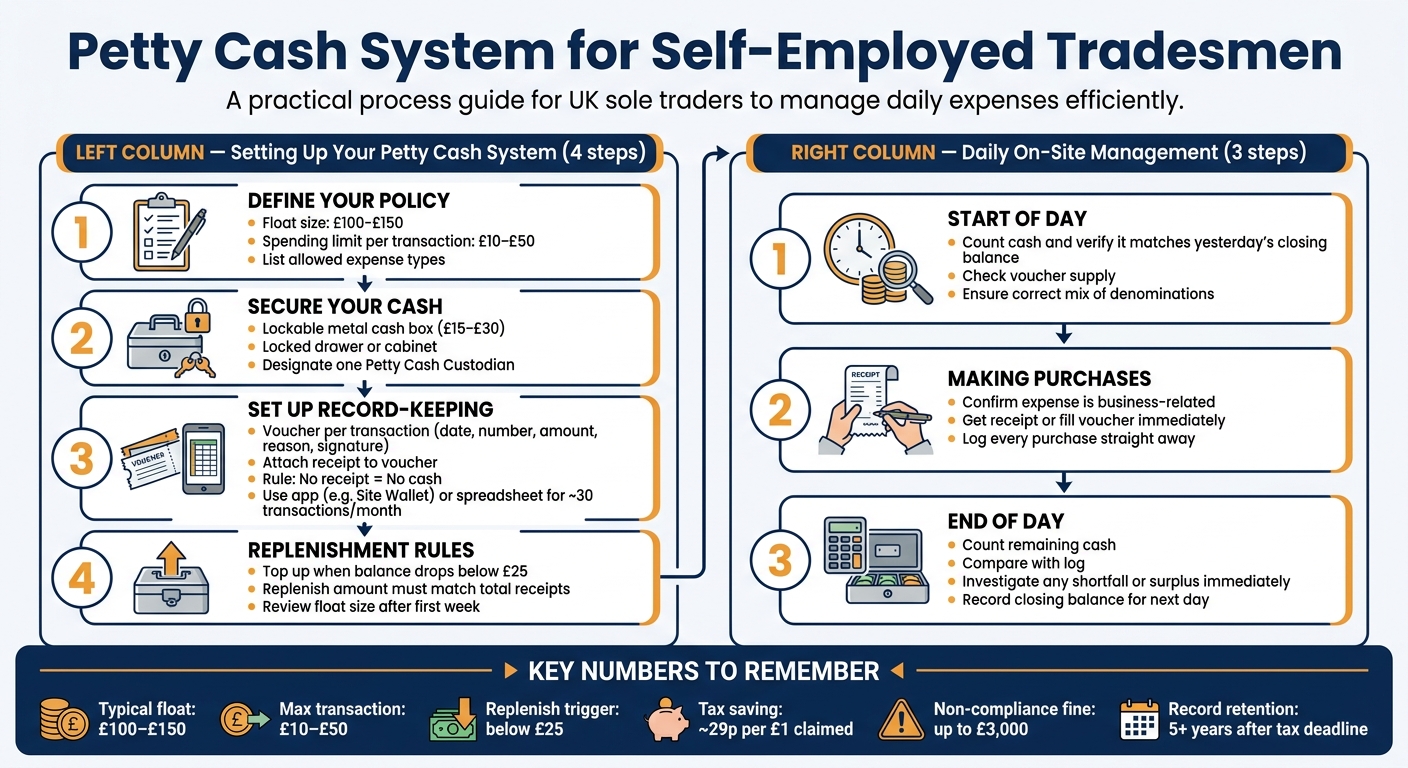
Petty Cash System Setup & Daily Management Checklist for Tradesmen
Setting up a petty cash system correctly from the outset can save you plenty of hassle down the line. Here’s a guide to creating a system that’s simple, secure, and compliant with HMRC regulations. By following these steps, managing your petty cash on a daily basis becomes much easier.
Define a Petty Cash Policy
Before distributing any cash, establish clear rules for how petty cash will be used. Start by deciding on your float size – for most sole traders, this is typically between £50 and £200. Next, set a spending limit per transaction, usually between £10 and £50. This ensures petty cash is reserved for minor expenses rather than larger costs that should go through your business account.
Clearly outline what types of purchases are allowed and explicitly exclude anything unrelated to business needs.
"The golden rule: treat petty cash with the same respect and rigour as your other business finances." - Ben Readhead, Howden Insurance
Secure Storage and Responsibility
Invest in a lockable metal cash box, which you can find for £15 to £30 at office supply stores. Keep the cash box in a locked drawer or cabinet – never leave it out in the open or store it in vehicles.
Designate one person as the Petty Cash Custodian. This individual – often yourself in the case of smaller businesses – will be responsible for authorising payments, collecting receipts, and ensuring the balance is accurate. Having one person in charge reduces the risk of errors or misuse and keeps everything organised.
Set Up Record-Keeping Tools
Every petty cash transaction should be documented with a voucher that includes the date, a sequential number, the amount, the reason for the expense, and a signature. Attach the receipt to the corresponding voucher.
For convenience, consider using a mobile app like Site Wallet, which allows you to scan receipts, tag expenses by category or job, and track your cash balance in real time. If your transaction volume is lower (around 30 per month), a simple spreadsheet can also do the job.
Stick to a strict rule: no receipt, no cash. Handing out money based on a promise to provide a receipt later often leads to problems.
Replenishment Rules
Replenish your float when the cash balance drops below £25. This ensures you won’t run out of funds unexpectedly and keeps the imprest system running smoothly. When adding cash, the amount should always match the total value of receipts and vouchers. If there’s a discrepancy, investigate it immediately before topping up the cash.
After your first week, review how well the system is working. Check if the float size aligns with your spending habits and whether the mix of notes and coins suits your typical purchases. Making small adjustments early on is much easier than overhauling the system later. Following these steps will make day-to-day operations and reconciliations far more manageable.
Checklist: Day-to-Day Petty Cash Management on Site
To keep your petty cash system running smoothly on-site, follow these daily steps. The key is consistency, especially when managing multiple sites or projects.
Before Starting Work
Kick off each day by double-checking your cash balance. Count the cash in hand and make sure it matches the closing balance from the previous day. If there’s a mismatch, investigate right away. Also, ensure you have enough vouchers and a mix of denominations to cover the day's needs.
"Begin each day with a clearly recorded amount of cash. The amount you end with should be the sum of your starting balance plus any money added, minus any money spent." - Chiral Accountants
Making Purchases
Before spending any money, confirm the expense is strictly business-related. If a receipt isn’t available, fill out a voucher immediately (you can use a photo as proof, as per HMRC guidelines). After each purchase, make sure it’s logged to prepare for the end-of-day review.
End-of-Day Reconciliation
At the end of the day, count the remaining cash and compare it with your log. If there’s a shortfall or surplus, note it as a discrepancy and investigate straight away. Below is an example of how a simple daily log might look:
| Date | Voucher # | Description | Money Out (£) | Running Total (£) |
|---|---|---|---|---|
| 11/06/26 | - | Opening Balance | - | 150.00 |
| 11/06/26 | V001 | Parking – Site A | 4.50 | 145.50 |
| 11/06/26 | V002 | Emergency washers | 2.20 | 143.30 |
| 11/06/26 | V003 | Milk for site | 1.80 | 141.50 |
After reconciling, record the closing balance to use as the next day’s opening balance. This simple habit ensures your records stay accurate and easy to manage over time.
Checklist: Weekly and Month-End Petty Cash Reconciliation
After managing your daily petty cash logs, it's essential to conduct regular weekly and monthly reviews. These checks not only help catch errors but also ensure compliance with HMRC regulations. By following a structured process, you can maintain both accuracy and accountability over the long term.
Weekly Petty Cash Review
Building on daily reconciliations, the weekly review ensures that your cash and receipts consistently match your starting float. At the end of each week, count the physical cash remaining and total all receipts and vouchers for the week. Under the imprest system, these figures should always add up to your original float. For instance, if your float is £150 and you've spent £41.50, you should have £108.50 in cash and £41.50 in receipts.
"At any point, your remaining cash plus your receipts should equal your starting fund amount." - Lena Hanna, CPA, Xero UK
If the numbers don’t add up, investigate immediately. Look for missing vouchers, unaccounted-for change, or calculation errors in your running total. Persistent discrepancies may indicate a need to lower transaction limits (e.g., from £50 to £20) or restrict access to the cash box to one designated individual.
Replenish the Float
Once reconciliation is complete, transfer the exact amount spent from your bank account to restore the float. Record this as a fund transfer to maintain accurate records.
Month-End and Year-End Reporting
The monthly review builds on weekly checks, consolidating all data for detailed reporting. Combine your weekly summaries into a single monthly report to finalise your records. Use this formula to check your figures:
(Opening Cash + Cash Receipts) − (Cash Banked + Cash Payments) = Closing Cash Balance
Additionally, categorise expenses - such as materials, travel, and site sundries - to make your Self Assessment tax return more straightforward.
HMRC requires self-employed individuals to retain petty cash records, including every voucher, receipt, and reconciliation summary, for at least five years after the 31 January tax return deadline. For VAT-registered businesses, ensure that receipts used to reclaim VAT include the supplier's VAT number and a clear breakdown of the VAT charged.
"HMRC treats these expenses the same as any other business expenditure. You'll need to retain all supporting documentation for at least six years, and ensure that only legitimate business expenses are paid from petty cash." - Ben Readhead, Howden Insurance
To simplify this process, consider using tools like Site Wallet. Features like receipt scanning and job-based tagging allow you to export detailed PDF or CSV reports at month-end, providing a digital audit trail and a backup in case physical receipts are lost.
Best Practices for Petty Cash Management
Managing petty cash effectively relies on keeping funds secure, maintaining detailed records, and backing up data digitally. These practices build on the earlier checklist and ensure your system runs smoothly and stays compliant every day.
Security Measures
The first step is physical security. Always store petty cash in a lockable metal tin or cash box, and keep this inside a locked cabinet or safe. This two-layered approach helps reduce the risk of theft.
Assign a single custodian to manage the petty cash, along with one authorised backup. Clear accountability makes it easier to trace any discrepancies and limits unnecessary access, ensuring better control.
"Having a lot of cash lying around (or hidden in your sock drawer) is a security risk – and usually one which isn't covered by your insurance." - Rachael Anderson, The Accountancy Partnership
It’s also a good idea to review your business insurance policy. Make sure it covers cash stored outside a fixed, locked location.
Once your cash is secure, the focus shifts to keeping accurate and thorough records.
Accurate Documentation
Good record-keeping is just as important as securing the funds. For every withdrawal, you should create a voucher that includes the following details:
- Date
- Unique voucher number
- Clear description of the expense
- Exact amount
- Required signatures
Attach the relevant receipt to the voucher for added clarity. Avoid vague terms like "miscellaneous" or "sundries" in your records, as HMRC may question these entries during an inspection. Instead, use specific descriptions, such as "masking tape and filler, B&Q, 04/06/2026", to ensure every entry is self-explanatory.
Another important rule: keep personal and business expenses completely separate. HMRC requires that business expenses be "wholly and exclusively" for your trade. Mixing personal and business spending can result in penalties.
Digital Tools and Backups
To protect your records further, digitise your documentation. In addition to keeping paper records, take a photo of every receipt as soon as you make a purchase. Digital copies are accepted by HMRC and can prevent issues like fading or accidental loss. Store these images in a dedicated folder, either on cloud storage or through a specialised app.
For example, Site Wallet is a tool built for this purpose. It allows you to scan receipts directly from your phone, assign each expense to a specific job, and track your cash balance in real time. At the end of the month, you can export a complete PDF or CSV report, creating a seamless digital audit trail without manual data entry. This is especially useful as Making Tax Digital (MTD) expands - from April 2026, sole traders earning over £50,000 will need to submit quarterly digital updates to HMRC.
Conclusion: Key Steps for Managing Petty Cash
A properly managed petty cash system can save time, ease year-end stress, and help ensure compliance with HMRC rules. To keep things running smoothly, make it a habit to: begin each day with a recorded balance, log every transaction as it occurs, and perform an end-of-day cash count to quickly identify any discrepancies. Accurate record-keeping is essential - not just for staying organised but also for financial benefits. For example, a basic rate sole trader can save approximately 29p in combined Income Tax and National Insurance for every £1 of legitimate business expense claimed. On the flip side, failing to comply with record-keeping requirements can lead to hefty fines and mandatory retention of records.
"Every pound you legitimately claim as an expense reduces the amount of tax you pay." - TaskDrop
The steps outlined earlier work together to create a reliable system. Tools like Site Wallet can make this process even easier. With features that allow you to scan receipts on-site, tag expenses to specific jobs, and export detailed reports at the end of the month, it simplifies the entire workflow. By combining daily balance checks, secure storage, and weekly reconciliations, you can maintain a dependable system - whether you're managing a £50 float or a £500 one.
FAQs
What counts as a petty cash expense with HMRC?
HMRC views petty cash payments just like any other business expense. For an expense to qualify, it must be wholly and exclusively related to your business activities. Typical examples include office supplies, postage costs, minor parking charges, small replacement parts, and refreshments such as tea or coffee intended for business use. It's crucial to hold onto all receipts and keep well-organised records for at least six years to ensure compliance with HMRC regulations.
What should I do if I lose a petty cash receipt?
If you’ve misplaced a petty cash receipt, here’s what you can do:
- Ask the supplier for a duplicate: Provide details like the approximate date and amount. Many suppliers retain records for up to six years, so they might be able to help.
- Use alternative proof for small expenses: If the amount is under £10, HMRC might accept your claim without a receipt, as long as you can provide a matching bank statement and prove it’s clearly for business purposes.
However, for expenses exceeding £10, HMRC is likely to reject your claim if you can’t provide a receipt.
How do I record petty cash top-ups in my accounts?
To handle a petty cash top-up, start by withdrawing the needed funds from your business bank account. Record this amount in your petty cash log, marking it as money added to the tin and ensuring the entry is dated. Update the running balance in the log to reflect the new total. Lastly, document the transaction in your general ledger by crediting the petty cash account and debiting the appropriate expense category.