

7 Common Petty Cash Mistakes Small Crews Make
Small crews often struggle with petty cash management, leading to financial confusion, compliance risks, and missed VAT reclaims. Here are the seven most frequent mistakes and how to avoid them:
- Poor Record Keeping: Failing to log expenses promptly disrupts job costing and risks HMRC penalties. Use digital tools to track receipts in real-time.
- Mixing Personal and Business Cash: Blending funds skews records and triggers audits. Keep finances separate with a dedicated business account.
- No Custodian: Without a designated person managing petty cash, accountability is lost. Assign a custodian and implement clear policies.
- Irregular Reconciliation: Delayed checks lead to discrepancies. Reconcile weekly and adopt the imprest system for better control.
- No Spending Rules: Undefined limits cause misuse. Set clear policies, including maximum transaction amounts and mandatory receipts.
- Incorrect VAT Records: Missing VAT invoices cost businesses money. Ensure receipts meet HMRC requirements and digitise them for durability.
- Delayed Expense Logging: Forgetting to record purchases creates gaps. Log expenses immediately using mobile apps.
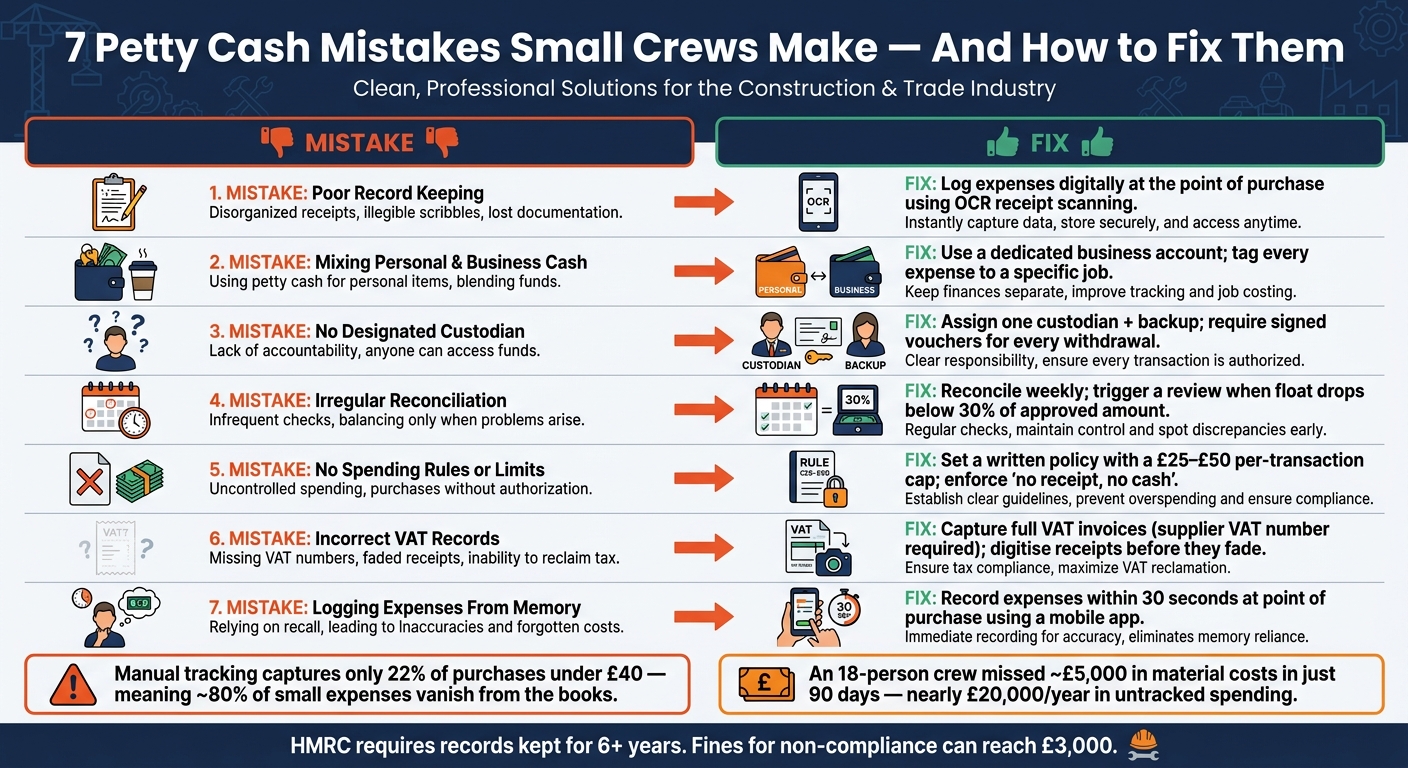
7 Petty Cash Mistakes Small Crews Make (And How to Fix Them)
Top 4 Reasons for Petty Cash Discrepancies
sbb-itb-12417dd
1. Poor or Nonexistent Record Keeping
Failing to keep proper records is one of the most common and damaging petty cash mistakes made by small crews. Imagine a labourer takes £10 from the cash float to buy cable ties, but no one logs the expense. That £10 effectively vanishes from your accounts. Now, multiply this scenario across multiple sites in a busy week, and suddenly, you’ve lost track of a significant chunk of your cash flow.
This lack of visibility doesn’t just disrupt your accounting - it directly impacts job costing. If you don’t track which expenses belong to which project, you can’t accurately measure a job’s profitability. You might think you’ve completed a two-week installation under budget, only to later discover that unrecorded site purchases have eaten into your margins. Worse still, this kind of sloppy record keeping can cause serious issues with HMRC compliance.
HMRC compliance is a real concern here. Starting April 2026, sole traders earning over £50,000 must comply with Making Tax Digital for Income Tax Self Assessment (MTD ITSA) by keeping digital records. Old habits like shoving a paper receipt in a drawer or saving a photo without proper details won’t cut it:
"A paper receipt kept in a drawer, or a photograph stored in your camera roll with no associated data, does not meet the [MTD] standard." - TapTax
The fix is simple: log expenses as soon as they occur. Tools like Site Wallet make this process seamless. Crew members can scan receipts on-site using OCR (Optical Character Recognition), which automatically pulls out key details. Each expense can then be linked to a specific job, giving you a real-time snapshot of project costs. This kind of detailed tracking is particularly crucial for CIS contractors, as HMRC requires them to record income and expenses separately for each project.
2. Mixing Personal and Business Cash
Picture this: a site foreman grabs £20 from the petty cash tin for lunch, or a sole trader pays for a personal item while picking up materials. This blending of personal and business finances, known as commingling, can wreak havoc on financial records and lead to serious trouble.
Why is this such a big deal? Mixing personal and business expenses skews profit margins, makes tax returns unreliable, and hides the true costs of running a business. Rachael Anderson from The Accountancy Partnership explains it well:
"Mixing personal and business money makes it harder to clearly show what's income, expenses, or owner withdrawals. That confusion can be the sort of red flag which triggers an HMRC audit."
HMRC has strict rules: for an expense to qualify as a business expense, it must be "wholly and exclusively" for business purposes. Their sophisticated "Connect" system even cross-checks bank data and social media to detect discrepancies in spending. For limited company directors, the stakes are even higher. Any personal spending from business funds must be recorded in a Director's Loan Account (DLA). If the DLA balance exceeds £10,000, it could result in Class 1A National Insurance Contributions and personal tax charges.
Here’s a quick guide to help distinguish between business and personal expenses:
| Expense Type | Business (Claimable) | Personal (Non-Claimable) |
|---|---|---|
| Clothing | PPE, branded workwear, safety boots | Personal clothing, unbranded "work" jeans |
| Travel | Site-to-site travel, parking, tolls | Commuting to a fixed base, visiting family |
| Food | Meals during business travel or meetings | Daily coffee runs, lunch at the usual job site |
| Materials | Site materials, tools, plant hire | Home DIY supplies, even if bought on a trade account |
(Source: Jones Financial Accounts)
To avoid these pitfalls, keep your business and personal finances separate. Use a dedicated business bank account and ensure petty cash is only used for legitimate site expenses.
Tools like Site Wallet make this process easier. When crew members log an expense, it’s instantly tagged to a specific job. This system not only prevents personal costs from sneaking through but also provides a clean, auditable record - essential if HMRC ever comes knocking.
3. No Designated Petty Cash Custodian
When petty cash is accessible to everyone, no one is truly accountable. Without a specific person in charge, keeping track of withdrawals becomes a guessing game, and any discrepancies might only surface weeks later. To prevent such chaos, assigning clear responsibility is crucial.
As Shopify explains: "Clear ownership prevents the 'I thought you were tracking it' scenarios that lead to discrepancies."
The solution? Appoint a single petty cash custodian, along with an authorised backup. This person would oversee all disbursements, log receipts, and conduct regular reconciliations. Every expense should be documented immediately, and only these designated individuals should have access to the cash box. Requiring receipts for every transaction also discourages unrecorded spending.
To make this role official, have the custodian sign the petty cash policy. This creates a formal transfer of accountability and ensures compliance with HMRC's record-keeping requirements.
Tools like Site Wallet can make this process even smoother. The app provides a centralised view of every transaction. Crew members can log expenses by scanning receipts and tagging them to specific jobs in real time. This way, the custodian always has an up-to-date record of who spent what and where.
4. Irregular Reconciliation of the Cash Float
Putting off float reconciliation can quickly lead to growing discrepancies. The longer you delay, the harder it becomes to figure out where the money went. Receipts might go missing, and minor mismatches can snowball into larger issues. This not only clouds financial oversight but also makes it tougher to allocate expenses promptly.
Skipping regular reconciliations also adds to compliance risks, as mentioned earlier. Construction teams often find themselves facing untraceable discrepancies running into thousands by year-end. Why? Because costs weren’t allocated to the right projects at the time of purchase.
"Job costing accuracy depends on expenses being captured and coded correctly at the time of purchase. A petty cash fund replenished in a lump sum forces the bookkeeper to reverse-engineer cost allocations after the fact." - Vergo
The solution is simple: reconcile the cash float regularly. Aim to do this at least once a week and always before adding more funds. A handy guideline is to trigger a review whenever the float drops below 30% of its approved amount. When done consistently, the process - counting cash, adding up receipts, and confirming the total matches the original float - usually takes just 15 to 20 minutes. Regular checks help ensure expenses are accurately tied to jobs, improving overall cost control.
Adopting the imprest system can make this even easier. With a fixed float (say £200), the sum of cash and receipts should always match that amount. Any discrepancies signal an issue that needs immediate attention. Tools like Site Wallet further streamline this by allowing crew members to scan receipts and tag them to specific jobs, giving the custodian a clear and current view of the float.
5. No Clear Spending Rules or Limits
When there are no written rules for petty cash usage, things can quickly get out of hand. Crew members end up relying on their own judgement, which often leads to the float being drained by purchases it was never meant to cover. For instance, someone might buy supplies for one job, fuel for another, and throw in a round of teas - all from the same cash pool, without properly allocating costs to specific jobs.
"Without a cap on individual purchases, petty cash can be misused for larger expenses." - Xero UK
The absence of proper expense-tagging skews job cost tracking, making it difficult to get an accurate read on profitability. To avoid this, implementing a written policy with a set spending limit - generally between £25 and £50 - is key. Such a policy should clearly define what petty cash is meant for (e.g., parking fees, emergency supplies, small consumables) and what it isn't (e.g., personal loans, IOUs, or recurring bills). A "no receipt, no reimbursement" rule is just as crucial - no receipt, no cash. This approach not only clarifies what’s allowed but also promotes accountability and compliance.
Adding signed vouchers and job-coded receipts to your process creates a reliable audit trail and tightens financial oversight. Digital tools like Site Wallet make this even easier by allowing crew members to tag expenses to specific jobs at the point of purchase. This ensures costs are allocated correctly and records are always ready for audits.
6. Not Recording VAT and Receipt Details Correctly
For VAT-registered teams, failing to keep complete and accurate receipts isn't just a minor issue - it can mean losing out on VAT reclaims. HMRC requires a valid VAT invoice for reclaiming input tax. Standard card machine slips or bank statements simply won't cut it.
"If your business is VAT registered, you can reclaim VAT on petty cash purchases, but only if you have proper VAT receipts. Illegible till receipts are insufficient." - Ben Readhead, Howden Insurance
Proper VAT documentation is essential for effective petty cash management. For purchases up to £250 (including VAT), a simplified VAT invoice is acceptable. However, for purchases exceeding £250, you’ll need a full VAT invoice. This must include your company name and address, a unique invoice number, a detailed description of the goods or services, and the total VAT amount. One of the most common reasons VAT claims are rejected is the absence of the supplier VAT registration number - a necessary 9-digit code that must appear on every receipt used for reclaiming tax.
"A single missing field on a VAT receipt can stop you reclaiming input tax." - Maxime Reding, Finance Engineer, Spendesk
Another challenge is the durability of till receipts, especially those printed on thermal paper. These can fade within 6–12 months, far short of HMRC's six-year retention requirement. To avoid this, photograph receipts as soon as you make a purchase. Tools like Site Wallet’s receipt scanning feature allow crew members to capture and store receipts digitally at the point of purchase, creating a permanent, legible record. This approach aligns with Making Tax Digital (MTD) rules, which have required VAT-registered businesses to maintain digital transaction records since April 2022. By digitising receipts, you not only ensure compliance with MTD but also avoid the risk of losing vital information due to fading.
7. Logging Expenses From Memory Instead of at the Time
Keeping expenses recorded promptly is just as important as regular reconciliations. Delays in logging even small purchases can lead to significant record gaps over time.
Take this scenario: a foreman picks up cable ties and tape from a builders' merchant and thinks, "I'll log this later when I'm back on site." But delays happen, and the details are forgotten. Multiply this across a team over a week, and you’re left with a big hole in the expense records.
Statistics show that manual tracking only captures about 22% of purchases under £40. That means nearly 80% of these small expenses vanish from the books. And these aren’t just minor losses. One study found that an 18-person electrical crew missed around £5,000 in material costs over 90 days. Over a year, this could balloon to nearly £20,000 in untracked spending.
This lack of timely recording doesn’t just affect records - it also skews job costing. Logging expenses from memory at the end of the day or week often leads to them being lumped into a general overhead category instead of being assigned to the correct project. This misallocation can make a project appear more profitable than it is - until reconciliations reveal the true costs. Worse, finance teams might only spot these patterns weeks after the money has already been spent.
The solution? Record expenses at the moment of purchase. Tools like Site Wallet’s mobile receipt scanning make this process quick and easy. Crew members can snap a photo of the receipt and log the expense in under 30 seconds, tagging it to the right job before leaving the store. This ensures every transaction is stored digitally with the correct project code, eliminating guesswork during reconciliations. For VAT-registered teams, it also means receipts are captured before they fade or get lost.
Conclusion
When it comes to managing petty cash, consistency plays a crucial role in safeguarding your business's finances. The seven common mistakes - ranging from inadequate record-keeping to failing to assign a custodian - highlight how minor lapses can lead to bigger financial headaches over time.
The good news? These issues are easily addressed. By introducing clear controls - such as appointing custodians, setting strict spending limits, reconciling frequently, and logging expenses right away - you can eliminate these pitfalls. These simple adjustments not only make day-to-day operations smoother but also help protect your business’s financial stability.
As accountant and small business adviser Éloïse Durand aptly notes:
"Petty cash is meant to be a quick way to buy things... but it quickly becomes a tangle of loose receipts, forgotten reimbursements and mystery transactions during bank reconciliation."
It’s also worth remembering that HMRC compliance is essential. Limited companies are required to keep records for at least six years, and failing to do so can result in fines of up to £3,000.
Using a dedicated digital platform like Site Wallet can make these processes even easier. With features like mobile receipt scanning, job-specific expense tagging, and exportable records, it ensures every transaction is accurately recorded and securely stored. Plus, it keeps your books HMRC-ready, reducing reconciliation time from days to mere minutes.
FAQs
What counts as a petty cash expense?
Petty cash is used to cover minor, day-to-day business expenses that would be inconvenient to handle through regular payment systems. Typical examples include buying office supplies like pens and paper, paying for postage, covering parking charges, fuelling company vehicles, handling minor repairs, or purchasing small tools. All purchases must adhere to your company’s set spending limits. It’s important to note that personal expenses are not allowed under any circumstances.
How often should we reconcile petty cash?
Reconcile petty cash at least weekly to maintain accurate records and identify any discrepancies promptly. Some businesses opt for daily reconciliations to maintain tighter control and ensure a continuous audit trail. Whatever your chosen frequency, always conduct a full reconciliation before requesting a float replenishment. Establishing a regular schedule is essential to confirm that the physical cash matches the recorded expenses.
What do we need on a receipt to reclaim VAT?
To reclaim VAT, having the correct documentation is crucial. For purchases exceeding £250, you’ll need a VAT invoice or receipt that includes:
- The supplier's VAT registration number
- Your business name and address
- A unique invoice number
- A clear description of the goods or services
- The VAT amount
For purchases of £250 or less, a simplified invoice will suffice. This should include:
- The supplier's name and address
- Their VAT registration number
- A description of the goods or services
- The total amount charged
- The VAT rate
Make sure the details are accurate to ensure a smooth VAT reclaim process.