
If your petty cash float is £200, then cash left + receipts + vouchers should always equal £200. That is the whole check.
I’d sum the article up like this: petty cash only works when one person looks after it, every spend is logged straight away, and the float is checked on a set routine. For small UK crews, that helps you keep job costs straight, support VAT claims with the right receipts, and avoid poor records that can lead to HMRC trouble, including fines of up to £3,000 per tax year.
Here’s the short version:
- Use a fixed float, such as £200
- Name one custodian to hold the box, log, and receipts
- Record every spend with date, amount, purpose, payee, job reference, and voucher number
- Set a small spend limit, often £25 or £50 per payment
- Reconcile weekly on busy sites, or monthly if cash use is low
- Count the cash and match it against receipts and vouchers
- Do not top up until any difference is checked and written down
- Keep records long enough: usually 6 years for limited companies, or 5 years after 31 January for sole traders and partnerships
- Scan receipts early, because thermal paper can fade
- If you’re VAT-registered, make sure receipts show the supplier’s VAT details so you can reclaim VAT
A simple example:
- Opening float: £200.00
- Total spend: £125.50
- Expected cash left: £74.50
If the box only holds £72.00, the float is £2.50 short and that gap needs checking before sign-off.
In short: petty cash is not hard to control. I’d keep it to one box, one custodian, one log, one routine, and make sure every pound has a paper trail.
How Is Petty Cash Reconciliation Recorded In Accounting Records? - Tax and Accounting Coach
sbb-itb-12417dd
Set up a simple petty cash system before you reconcile
Start with the basics: a fixed float, one custodian, a lockable box, a log, and numbered vouchers. Once those controls are in place, each withdrawal is much easier to track.
| Setup Element | What It Means | Key Control |
|---|---|---|
| Custodian | One named person responsible for the box, log, and receipts | The custodian should not approve their own withdrawals |
| Float Amount | Fixed sum sized to cover roughly two weeks of minor site spend | Small enough that any loss stays limited; large enough to avoid constant top-ups |
| Storage | Lockable cash box with restricted key access | Keep the petty cash separate from personal cash or other funds |
| Petty Cash Log | Running ledger of every payment in and out | Must show a running balance at all times |
| Vouchers | Pre-numbered slips for every withdrawal | Any gap in the sequence flags a missing record |
Choose a fixed float and assign clear roles
Set the roles clearly from day one. You need three people, or at least three separate duties: the approver who signs off each spend, the custodian who holds the box, and the person who does the periodic independent check.
Why split those jobs? Because it stops one person from both approving and handling a withdrawal without oversight. That makes the later cash count and receipt match much more dependable. These should not all sit with the same person.
It also helps to set a cap for each transaction. Around £25 or £50 is common for small crews. Anything over that should go through a card payment or a formal purchasing route, not the petty cash box.
Record every payment with the right details
Give out a pre-numbered voucher for every withdrawal. Write the amount in figures and words to cut down the chance of alteration. Then attach the supplier receipt to the voucher and file both with the log.
Each petty cash log entry should show:
- the date
- the amount
- the payee
- the purpose
- the job or site reference
- the voucher number
- the running balance
For small crews working across more than one site, the job or site reference matters a lot. It makes sure the cost lands against the right job instead of getting lost in the mix.
If the business is VAT-registered, the receipt should also show the supplier's VAT number and a clear tax breakdown. That gives you the paper trail needed for reconciliation.
If there is no receipt, use a signed exception note from the custodian, then get it countersigned by the approver. No voucher, no cash. Once every spend is logged properly, the count-and-match step becomes much simpler.
How to reconcile petty cash step by step
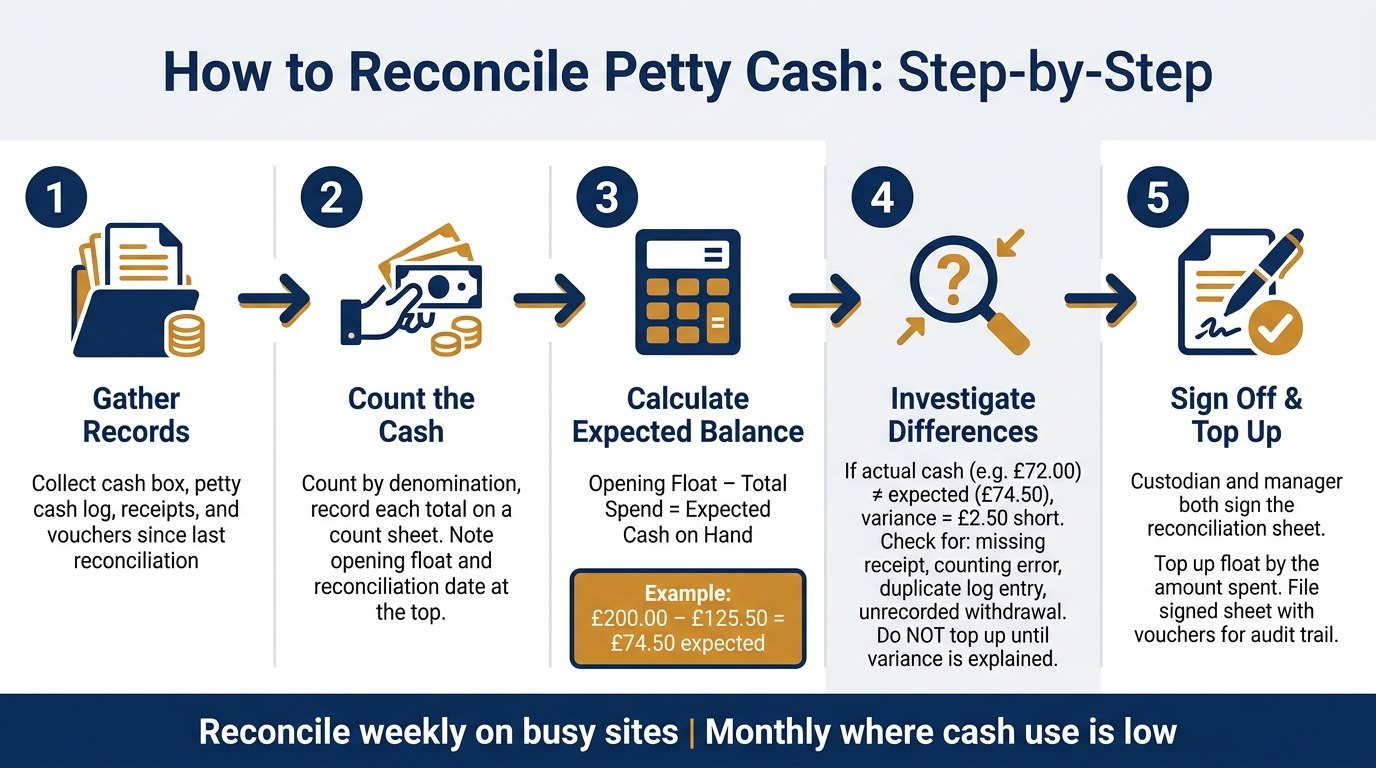
Petty Cash Reconciliation: Step-by-Step Guide for Small Crews
Reconcile weekly on busy sites where cash moves every day, and monthly where cash is used less often. Stick to the same routine each time: count, match, check, resolve, then top up.
Gather records and count the cash
Start by pulling together the cash box, petty cash log, receipts, and vouchers from the last reconciliation.
Then count the cash by denomination and write down each total on a count sheet. Put the opening float and the reconciliation date at the top of the sheet.
Match receipts and calculate the expected balance
After counting the cash, total all spending for the period. Then run this check:
Opening Float − Total Spend = Expected Cash on Hand
Now compare that figure with the cash you actually have. For example, an opening float of £200.00 minus total spend of £125.50 gives an expected cash balance of £74.50. If the counted cash is £72.00, the variance is £2.50 short.
This simple bit of maths should show any gap straight away.
Once the reconciliation report is finished, both the custodian and a manager should sign it off.
Investigate differences and top up the float
If the expected and actual cash figures do not match, you need a reason before doing anything else. Common causes include:
- a missing receipt
- a counting error
- a duplicate log entry
- a withdrawal that was never recorded
Start with a second cash count, with another person present. Then review the log for missing voucher numbers and duplicate entries. If the shortfall still cannot be explained, record it as a shortage and sort it out before sign-off.
Do not top up the float until the variance has been explained and the sheet has been signed. Once the difference is cleared up, sign off the sheet and top up the float by the amount spent.
File the signed reconciliation with the vouchers so it is ready for the next count and for the audit trail.
Controls and digital records that reduce petty cash errors
Keep petty cash secure and easy to check
Once the float balances, the next step is simple: stop the same mistakes from creeping back in. For small crews, the weak spots are usually the same ones every time - missing receipts, shaky handovers, and counts that happen too late.
A fixed float helps keep things clear. Store the cash in a lockable box, separate approval from custody, put a cap on small spends, run surprise counts every quarter, and scan every receipt. The custodian should not approve replenishment. A per-transaction cap of £25 or £50 also keeps petty cash in its lane, so anything above that goes through a formal process.
Record-keeping matters too, especially for bookkeeping and VAT claims. Limited companies must keep records for at least 6 years from the end of the relevant financial year. Sole traders and partnerships must keep them for at least 5 years after the 31 January submission deadline. Scan receipts straight away because thermal paper fades fast.
Use Site Wallet to speed up receipt capture and job tracking

On site, missing or faded receipts cause most of the trouble. Site Wallet helps crews deal with that on the spot.
With Site Wallet, teams can:
- Scan receipts on site
- Tag each spend to a job
- Track cash as it moves
- Export records as PDF, CSV or ZIP
That means less chasing paper later and a cleaner record of where the money went.
Conclusion: A simple routine that keeps petty cash accurate
Petty cash issues tend to creep in bit by bit: one missing receipt, one late count, and before long the float no longer balances. The answer is simple: consistency.
These checks only do their job when they become part of the weekly routine. Stick to one fixed float, one custodian, and one weekly count. Record each payment on the day it happens, file receipts by job, and top up before the float runs dry.
For small UK crews, the rule is straightforward: cash in the box plus receipts must always equal the fixed float. That keeps petty cash accurate, ready for audit, and useful for job costing.
FAQs
Who should reconcile petty cash?
The petty cash custodian, often a named staff member or site engineer, should handle or assist with regular reconciliations. The aim is simple: the cash left in the tin, plus the receipts on file, should add up to the original fund amount.
For sound internal control, this job should sit with someone other than the person who reviews the register. Owners or managers should also carry out unannounced spot checks or audits from time to time.
What if a receipt is missing?
Treat it as a documented exception.
Record the expense on a petty cash voucher. Include the date, amount, purpose, recipient, approvals, and the reason the receipt was missing.
When reconciling, count the cash and add the vouchers. The cash plus receipts should match the original float. If there’s any difference, check it at once and record it as an overage or shortage straight away.
How often should petty cash be checked?
Check and reconcile petty cash at least once a month. If it’s used a lot, such as on busy sites, do it more often, like weekly or fortnightly.
The cash left in the tin, plus any receipts or vouchers, should add up to the original fund amount. If the numbers don’t match, look into it straight away.