
If your petty cash float is £250.00, then cash in hand + valid receipts must add up to £250.00. That is the whole check.
I’d sum this up like this:
- Confirm the float
- Count the cash
- Check the receipts
- Find missing or unsupported spend
- Match each cost to the right job or site
- Compare the total to the float
- Record any over/short gap and top the float back up
This matters because small cash spends can stack up fast. One parking fee, one pack of fixings, one missing receipt - and by month-end the numbers stop lining up. HMRC also expects business expense records to be kept, and sole traders need to hold them for at least 5 years after the 31 January self-assessment deadline.
A monthly check helps me keep three things straight:
- job costs
- cash left in the tin
- receipt proof for each spend
If I only keep one rule in mind, it’s this: don’t force the figures to fit. If the total is off, I log the gap, note the reason if I have it, and keep the record clear.
Below is the short version of the full process in one place.
| Step | What I do | Why it matters |
|---|---|---|
| 1 | Confirm the approved float | Gives me the target figure |
| 2 | Count notes and coins | Shows cash actually left |
| 3 | Review receipts and vouchers | Checks proof for each spend |
| 4 | Find missing entries or weak backup | Spots gaps in the record |
| 5 | Tag each spend to a job or site | Keeps job costing in order |
| 6 | Compare cash + receipts to float | Shows if the fund balances |
| 7 | Save the month-end record and refill | Resets the float for next month |
Example: if I start with £250.00, count £87.50 in cash, and have £162.50 in valid receipts, the fund balances at £250.00.
So before I close the month, I make sure I’ve got the cash count, the receipts, the log, and the final total all in one record.
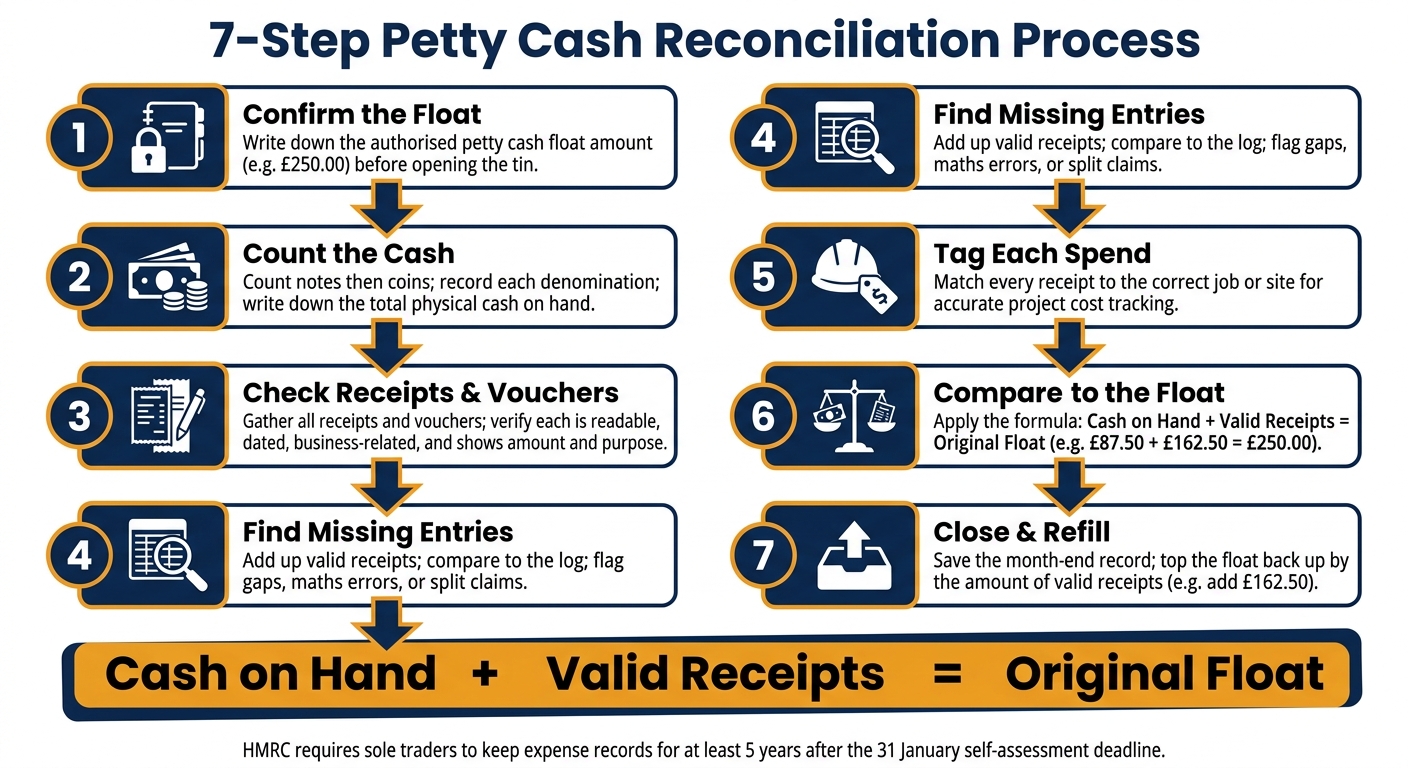
7-Step Petty Cash Reconciliation Process
How Is Petty Cash Reconciliation Recorded In Accounting Records? - Tax and Accounting Coach
sbb-itb-12417dd
The 7-step petty cash reconciliation process
Work through these steps in order. Each one sets up the next, so jumping ahead usually means doubling back later.
Step 1: Confirm the approved petty cash float
Before you open the cash tin, write down the authorised float amount. That’s the figure you’re checking everything against.
Step 2: Count the cash on hand
Count notes first, then coins. Record each denomination clearly - for example, three £20 notes, two £10 notes, and four £1 coins - then add them up.
This small bit of discipline makes the count easier to verify and gives you a cleaner audit trail.
Write down the total amount of physical cash.
Step 3: Check every receipt and voucher
Pull together every receipt, voucher, and supporting slip for the period. Check that each one is readable, dated, business-related, and shows the amount, purpose, and approval.
If something is missing, or a slip looks like a photocopy instead of the original, put it to one side and deal with it in Step 4.
Step 4: Find missing entries and unsupported spend
Add up the valid receipts and vouchers, then compare that figure with the log. Any difference between the two points to a missing entry - cash that left the tin without backup.
Also check the log for maths errors. And keep an eye out for split claims used to get around approval limits. Make a note of every gap or oddity before moving on.
"Missing receipts are the biggest petty cash headache for 53% of organisations, which shows most of the pain is really about paperwork, not the money itself." - Alaan
Once the paperwork lines up with the log, tag each spend to the right job or site.
Step 5: Tag each spend to the correct job or site
Match each receipt to the correct job or site. This is where a basic cash check starts to become useful project data.
Step 6: Compare the total against the starting float
Now pull the figures together with the imprest formula:
Cash on hand + valid receipts should equal the original float.
Say your float is £250.00, you have £87.50 in the tin, and receipts come to £162.50. In that case, the reconciliation balances.
If the numbers don’t match, record the difference as an over/short entry before you do anything else. Don’t try to make the figures fit. The gap tells you something, and it needs to be recorded.
Step 7: Close the month-end record and refill the float
When the figures balance, close the record and refill the float. Save the reconciliation on mobile with the opening float, cash on hand, receipt total, and any over/short amount as your month-end record.
Then top the float back up to the authorised amount. The replenishment figure should match your documented expenses. So if valid receipts total £162.50, you put £162.50 back into the tin to return the float to £250.00.
How to handle mismatches without slowing down the crew
If the month-end total doesn't balance, use this quick process to keep the close moving.
What to do when cash and receipts do not match
Recount the cash with another crew member there. If the second count shows the same result, check the petty cash log line by line and match each entry to its voucher. Then record the difference as a cash short or cash over entry.
If anything looks unclear, flag it for review so the audit trail stays intact without holding up month-end reconciliation.
How to document a missing receipt
If a receipt is missing, create a petty cash voucher or no-receipt memo with:
- the amount in £
- the date
- who took the cash
- the job or site
- the purchase purpose
- why the receipt is missing
Keep the entry flagged as unverified until an approver has reviewed it. If there's still a chance of getting the original, ask the supplier for a duplicate.
Save the discrepancy note with the month-end record.
Simple records to keep on mobile
Keep petty cash records on your phone so month-end checks stay quick and low-stress.
The 3 figures to save every time
After each count, save these three figures. If you do that every time, month-end is much easier.
| Figure | What It Is |
|---|---|
| Cash on Hand | The physical notes and coins left in the tin or wallet after the count |
| Total Valid Receipts | The sum of all expenses backed by a receipt or voucher |
| Original Float | The approved starting balance, such as £200, that the other two figures must equal |
Use this check: cash on hand + valid receipts = original float.
Those figures also need the right backup: receipts and job tags.
What to archive with the month-end reconciliation
Once everything balances, save the month-end evidence in one file. That record should include:
- the signed-off cash count
- receipt photos
- exception notes for any missing vouchers or variances
- job tags for each spend
- a final PDF, CSV or ZIP export
A tool like Site Wallet can help with receipt scanning, job tags and exports.
Keep digital records clear to read and stored for the HMRC retention period.
Conclusion: A 7-step routine that keeps petty cash accurate
Petty cash rarely goes off track all at once. It usually slips bit by bit: one missing receipt, one spend with no job tag, one note that never gets written down. Then month-end rolls around and you're left trying to work out why the cash tin is short. Run this routine every month, in the same order, and those small mistakes are far easier to spot before they turn into a bigger mess.
For UK tradesmen and small crews, clean petty cash records help protect cash flow, make sure job costs are assigned to the right work, and cut down the admin that stacks up over time. That means less hassle at month-end and a clean audit trail if you need to check anything later.
Site Wallet helps keep this process simple by scanning receipts, tagging job costs, and exporting month-end records - easy to use on site.
FAQs
How often should I reconcile petty cash?
Reconcile your petty cash fund at least once a month. If your crew uses it a lot, weekly or fortnightly checks can help keep your records accurate and spot any discrepancies early.
You should also reconcile the fund whenever it needs topping up. Regular checks help you stay in control of day-to-day spending and keep your records ready for accounting and tax purposes.
Who should approve a missing receipt?
If getting a receipt is genuinely impossible, the custodian should fill in and sign a no-receipt memo that explains what happened. That memo must then be countersigned by the person who has approval authority for that amount.
One point matters here: the custodian should never approve their own vouchers or missing receipt memos. That kind of self-approval weakens the control process.
If no-receipt memos start showing up often, treat that as a warning sign. Review your petty cash process and tighten the controls.
What counts as a valid petty cash receipt?
A valid petty cash receipt needs to show that the expense was incurred wholly and exclusively for business use. It should clearly show the supplier’s name, the purchase date, the total amount, and any VAT breakdown.
HMRC accepts digital copies as long as they’re legible, stored securely, and kept for the required period. If you can’t get a formal receipt, use a petty cash voucher that explains the expense, states its purpose, and includes an approval signature.